

Hey there! As a supplier of bimetal thermometers, I'm super excited to chat about their applications in HVAC (Heating, Ventilation, and Air Conditioning) systems. Bimetal thermometers are pretty nifty devices, and they've got a bunch of uses in the HVAC world.
Let's start with the basics. A bimetal thermometer works on a simple principle. It's made up of two different metals bonded together. These metals expand at different rates when heated. As the temperature changes, the bimetal strip bends, and this bending movement is used to indicate the temperature on a scale. It's a reliable and cost - effective way to measure temperature.
One of the main applications of bimetal thermometers in HVAC systems is temperature monitoring in air handling units (AHUs). AHUs are like the heart of an HVAC system. They condition the air by heating, cooling, humidifying, or dehumidifying it before distributing it throughout a building. Bimetal thermometers can be installed in the supply and return air ducts of AHUs. For example, we can use an Adjustable Angle Bimetal Thermometer in these ducts. Its adjustable angle feature allows for easy installation and accurate temperature reading, no matter the orientation of the duct. By monitoring the air temperature, technicians can ensure that the AHU is operating at the right temperature setpoints. If the supply air temperature is too high or too low, it could indicate a problem with the heating or cooling coils, and timely action can be taken to fix it.
In addition to air handling units, bimetal thermometers are also used in chiller systems. Chillers are used to cool water, which is then circulated through the building to provide cooling. The temperature of the chilled water needs to be carefully controlled. A Bimetallic Type Temperature Gauge can be installed at the outlet of the chiller to monitor the temperature of the chilled water. If the temperature is not within the desired range, it could mean that the chiller is not operating efficiently, or there could be an issue with the refrigerant flow. By having a reliable temperature gauge, operators can make adjustments to the chiller settings or perform maintenance as needed.
Another important area in HVAC systems where bimetal thermometers come in handy is in boiler systems. Boilers are used to heat water or produce steam for heating purposes. The temperature of the water or steam needs to be precisely controlled to ensure safe and efficient operation. A Bimetal Thermometer With Sanitary Flange can be installed in the boiler's water or steam lines. The sanitary flange makes it easy to install and remove the thermometer for cleaning and maintenance, which is crucial in applications where hygiene is important. By monitoring the boiler temperature, operators can prevent overheating, which could lead to equipment damage or even safety hazards.
Bimetal thermometers are also useful in room temperature control. In large commercial buildings, different zones may have different temperature requirements. Bimetal thermometers can be installed in individual rooms or zones to monitor the temperature. This information can be used by the HVAC control system to adjust the supply of heated or cooled air to each zone. For example, if a room is too warm, the system can increase the supply of cooled air to that room. This helps in maintaining a comfortable environment for the occupants and also saves energy by not over - conditioning areas that don't need it.
Now, let's talk about some of the advantages of using bimetal thermometers in HVAC systems. First of all, they are very reliable. Unlike some electronic sensors that can be affected by electrical interference or power outages, bimetal thermometers work purely on a mechanical principle. They don't require any external power source, which means they can continue to function even during a power failure. This is especially important in critical applications where continuous temperature monitoring is essential.
Secondly, bimetal thermometers are relatively inexpensive. They are a cost - effective solution for temperature measurement in HVAC systems, especially for applications where high - precision electronic sensors are not necessary. This makes them a popular choice for many HVAC contractors and building owners.

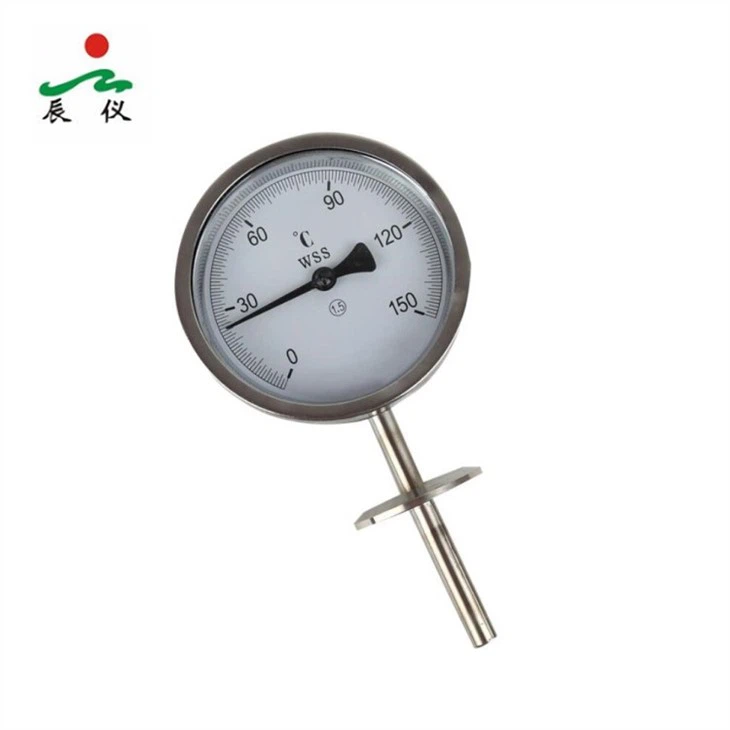
They are also easy to install and maintain. Most bimetal thermometers come with simple mounting options, and they don't require any complex calibration procedures. If a thermometer needs to be replaced, it can be easily removed and a new one installed in its place.
However, it's important to note that bimetal thermometers also have some limitations. They may not be as accurate as some electronic sensors, especially in applications where very precise temperature measurement is required. Their response time can also be slower compared to electronic sensors. But for many HVAC applications, the level of accuracy and response time provided by bimetal thermometers is more than sufficient.
In conclusion, bimetal thermometers play a vital role in HVAC systems. They are used in air handling units, chiller systems, boiler systems, and room temperature control. Their reliability, cost - effectiveness, and ease of installation and maintenance make them a popular choice for temperature measurement in the HVAC industry.
If you're in the market for bimetal thermometers for your HVAC system, we've got a wide range of products to meet your needs. Whether you need an adjustable angle thermometer, a bimetallic type temperature gauge, or a thermometer with a sanitary flange, we can provide you with high - quality solutions. Get in touch with us to discuss your requirements and start a purchase negotiation. We're here to help you keep your HVAC system running smoothly.
References
- ASHRAE Handbook - HVAC Systems and Equipment. American Society of Heating, Refrigerating and Air - Conditioning Engineers.
- HVAC Systems Design Handbook. McGraw - Hill Professional.
