Chongqing Haichen Instrument Co., Ltd.

RTD Sensor

Why Choose Us


Products widely used
Haichen products are safe and reliable, and are widely used in various fields such as steel, petroleum, chemical industry, light industry, building materials, environmental protection, food, power stations, aerospace, ships, etc.


Professional technical team
After years of independent research and development, Haichen now has strong production capacity, large production scale, advanced testing equipment, and a professional technical team.


QC
Strictly tested and inspected before shipment. Organize shipments with long-term freight forwarders, which are reliable and cheap.


Customer service
After shipment, we can notify customers of the tracking number so that customers can track the goods in time. If there are any problems with the product during use, you can contact us at any time by email or phone. We can try to resolve the issue within 24 hours.


What is RTD Sensor


An RTD sensor is a type of temperature sensor that changes resistance in response to temperature changes. Usually a 100 ohm platinum element, known as a Pt100, is used where the relationship between resistance and temperature is standardised and repeatable. RTD's are passive, meaning they do not generate an output on their own but use electronic devices (indicators) to measure the sensor's resistance by passing a small current (typically 1mA) through the sensor, which in turn generates a voltage. The resistance of the sensor increases as the temperature increases and are provided in our resistance vs temperature tables.


  • Sanitary RTD Probe

    Sanitary RTD Probe

    Sanitary RTD Probes are one type of widely used in food industry. Its common mark is PT100, with

    Add to Inquiry
  • Pt100 Surface RTD

    Pt100 Surface RTD

    Pt1000 4 Wire RTD is suitable for measuring the temperature of fixed surface, especially for steam

    Add to Inquiry
  • WZPM PT100 RTD Sensor with Kapton Tape

    WZPM PT100 RTD Sensor with Kapton Tape

    Pt100 RTD sensor is one type of widely used industry thermometer, can be treated as standard

    Add to Inquiry
  • Pt1000 Resistance Temperature Detector

    Pt1000 Resistance Temperature Detector

    RTD usually use a platinum thin film resistance element to test temperature from -200°C to 600°C.

    Add to Inquiry
  • Pt100 Thermosensor

    Pt100 Thermosensor

    Pt100 Thermosensor is one of the most commonly used temperature detectors in low and medium

    Add to Inquiry
  • WZP Pt100 Temperature Sensor

    WZP Pt100 Temperature Sensor

    WZP Pt100 Temperature Sensor is one type of widely used industry thermometer, can be treated as

    Add to Inquiry
  • Pt100 Platinum Temperature Sensors

    Pt100 Platinum Temperature Sensors

    Pt100 Platinum Temperature Sensor is a kind of mineral insulated thermal resistance. It mainly

    Add to Inquiry
  • Acid Proof Pt100 Temperature Sensor

    Acid Proof Pt100 Temperature Sensor

    Acid Proof Pt100 Temperature Sensor is one type of widely used industrial thermometer, can be

    Add to Inquiry
  • 6 Wire Pt100 RTD

    6 Wire Pt100 RTD

    6 Wire Pt100 RTD is a very simple and durable temperature sensors. It is come with different

    Add to Inquiry
  • RTD PT200 Probe

    RTD PT200 Probe

    RTD PT200 Probe measures temperature by utilizing the characteristics as follows: when the material

    Add to Inquiry
  • 3D Printer RTD

    3D Printer RTD

    3D Printer RTD mainly installs in the machine like 3D printer, mechanical equipment mold, injection

    Add to Inquiry
  • Thermal Resistance Probe

    Thermal Resistance Probe

    Thermal Resistance Probe is suitable for measuring the temperature of fixed surface, especially for

    Add to Inquiry
First 12 Last 1/2

Benefits of RTD Sensor


Cost
RTD sensors are more expensive than other temperature measuring methods. Cost savings are realized in their accuracy, longevity, repeatability, and stability.


Sensitivity
A major requirement for a sensor is that it provides data instantly. RTD sensors provide temperature readings quickly and accurately. Improvements to thin film pt100s have substantially improved sensor response time.


Accuracy
The main reason for the popularity of RTD sensors is their accuracy, which is within 0.1°. The exceptional accuracy of RTD sensors is due to their linearity.


Linearity
Linearity is the ability of a sensor to respond to changes in temperature as they occur across the full range of possible temperatures. A device with high linearity provides a resistance change that matches that of the device. This particular factor is the main reason that RTD sensors are so accurate and reliable.


Stability
The stability of a device is its ability to provide accurate and precise readings over a long period of time. Readings from RTD sensors are constant, stable, and repeatable for longer than any other form of temperature sensor. The stability of a sensor is measured by its amount of drift or lack of linearity.


Elements
RTD sensor elements are made of pure high quality metals; this is essential for their performance and the quality of their readings.


Temperature Range
A pt100 RTD sensor is capable of measuring temperatures from -330° F (-201° C) to 1560° F (848° C). Its variable and wide temperature range make it adaptable for most industrial applications.


Types of RTD Sensor Elements
 
 
Platinum

Platinum sensor elements are made of pure platinum wire and have a positive temperature coefficient. The linear and long term stability of platinum RTD elements make them an extremely accurate sensor for industrial applications. Platinum RTD elements can use copper wire extension leads and are suited for industrial applications that have a wide temperature range that requires stability and linearity.

 
Nickel

Nickel elements have a limited temperature range due to the amount of resistance per degree of temperature change and become non-linear over 300°C or 572°F, which throws off temperature processing and requires error corrections. They have good corrosion resistance and are less expensive than platinum RTDs but age rapidly and lose their accuracy. Their temperature range is -80°C to 260°C or -112°F to 500°F.

 
Copper

Copper has good linear resistance in relation to temperature change but needs a longer element than platinum because of its low resistivity forces. The fact that copper oxidizes limits its use to temperatures under 150° C or 302° F. The uses of copper RTDs are limited to winding measurements for motors, generators, and turbines.

 
Balco

Sensors made of Balco are an annealed resistance alloy of 70% nickel and 30% iron. A Balco 500 ohm sensor provides a relative linear resistance at temperatures between -40° to 116° or -40° to 240°. Balco has the same thermal conductivity as nickel but with twice the resistivity. Much like copper, Balco RTD sensors are low cost with a high resistance coefficient and exceptional linearity as well as strong mechanical properties and some corrosion resistance.


Types of RTD Sensor


Thin-film RTDs

The thin-film RTD elements are made by depositing a thin layer of metal which in most cases is platinum on a ceramic substrate material. The metal film is laser cut or etched into an electrical circuit pattern that provides the specified amount of resistance. Lead wires are then attached, and a thin protective glass coating is applied to the entire element.The advantages of thin-film RTDs are that they are reliable and are produced at a low cost. Moreover, they are more damage resistant from vibrations than the other types of resistance temperature detectors.

Wire-wound RTDs

The other type of RTD is wire-would. Its sensing element comprises a small coil of ultra-thin platinum wire. The wire coil is commonly packaged inside a ceramic or glass tube or the wire can be wound around the outside of a ceramic or glass housing material.
The advantages of wire-wound RTDs are that they are very accurate and those with glass cores can readily be immersed in many liquids, while those with ceramic cores can be used to accurately measure extremely high temperatures.The disadvantages of wire-would RTDs are that they are more expensive to produce than thin-film and they are more vibration-sensitive.

Sanitary RTD Probe


Application of RTD Sensor
 

Food Processing
Every aspect of food production requires constant monitoring of temperature. RTD sensors are used during manufacturing, storage, and shipping.


HVAC
RTD sensors are used for monitoring temperature, fire detection, and climate control.


Aerospace
The use of RTD sensors for aerospace is somewhat like their application in the auto industry. In aerospace, they monitor the temperatures of engines, coolant, and compressors as well as fuel tanks and fire control equipment.


Heavy Industry
All machinery and electric motors have to be monitored for increases in temperature, which could significantly damage production. This is also true of windings, generators, ovens, and microwave power.


Medical
Temperature control is crucial to patient care, especially in cases of infant incubators, respiration devices, and dialysis equipment.


Communications
In sound production, amplifiers and transmitters use tremendous amounts of heat producing electricity that has to be controlled and monitored.


Consumer Products
An endless number of consumer products use RTD sensors as a means of controlling temperature. From coffee makers and cellphones t°lothing washers and electric blankets, RTD sensors ensure constant and safe temperature control.


Components of RTD Sensor
 

Resistance Elements

All metals produce resistance when there is a change in temperature. Elements for RTD sensors are specifically chosen for their linearity during temperature change. The first RTD sensor used copper as its element; it was eventually discovered that platinum performed better and gave more accurate readings.

Wires

Copper is the most common metal used for wire leads for two, three, or four wire RTDs and is insulated with a variety of materials that include fiberglass, Teflon, and various types of plastic. Wire leads are required to be a specific length to meet the resistance requirements of the RTD and connect it to the read out device.

Tubing Material

Common tubing materials are stainless steel and Inconel. Stainless steel is recommended for RTD sensors used at temperatures up to 500° or 260°. When the application temperature is above 500° or 260°, Inconel is recommended. The tubing material has to match the durability of the RTD sensor and be adaptable to the many conditions in which the sensor will be used.

Connection Fitting

The connection fitting securely joins the RTD sensor with the application and includes fittings used for other temperature measuring equipment. Two common metals used for producing fittings are brass and stainless steel. Brass is chosen for its corrosion resistance, while stainless steel is corrosion and chemical resistant. Fittings are designed for easy installation of the sensor and securing of the wire leads such that they will not be twisted or crimped.

Outer Diameter

The outer diameter of RTD sensors come in a wide range of sizes but are normally between 0.063 inches (1.6 mm) and 0.5 inches (12.7 mm).

Termination

The termination connects the RTD sensor to the monitoring device. The connection can be completed in a variety of ways, including soldering and crimping. The termination on the cold end comes in several forms that include bare plain wires and different types of plugs and jacks.


The Difference Between RTD Sensor and Thermocouples Sensor
 

Cost
A thermocouple costs less than RTD Sensor, which cost two to three times more than a thermocouple, and are capable of reading the same temperature ranges. The difference in cost between thermocouples and RTD Sensor is due to the lower production costs for producing thermocouples. Additionally, thermocouples necessitate regular adjustments and calibrations as well as longer setup and installation time.


Measurement Range
RTD Sensor are capable of measuring temperatures up to 1000°C though it can be difficult to get accurate readings above 400°C. Thermocouples can measure temperatures up to 1800°C. When making the choice of which instrument to use, the general rule is to use a RTD Sensor for temperatures below 850°C. For temperatures above 850°C, it is best to use a thermocouple.The majority of industrial applications operate between 200°C and 400°C, which makes RTDs the best choice.


Response Time
RTD Sensor and thermocouples respond quickly to variations in temperature with thermocouples being slightly faster. There are various adjustments that can be made to RTDs to enhance their response time.


Dimensions
There is little difference in the dimensions of the two instruments. They are small with a diameter of 0.5 mm. Though it is doubtful, it may be necessary to check the mounting location to see which device will fit.


Vibrations
The construction and design of RTD Sensor makes them susceptible to failure in environments where there are vibrations. Thermocouples are unaffected by vibrations and are capable of supplying readings in those conditions.


Self-Heating
RTD Sensor require a power supply and voltage to operate. The necessary power is 1mA up to 10 mA and is minimal but can cause the RTD's platinum element to heat up, which will affect its accuracy. Thermocouples do not require a power supply and are unaffected by heat.


How an RTD Sensor Works
 
6 Wire Pt100 RTD
 

Insertion

When placing the sensor in the line, it is important that the cables on the connecting head are straight and not twisted while screwing in the sensor. Leaving the wires disconnected when inserting the sensor avoids problems with the cables.To ensure a good calibration, all of the connecting wires should be the same size and length. The insertion depth should be ten times the diameter of the stem.The diagram below is an example of an inserted RTD sensor using a thermowell.


Calibration

Frequency with which an RTD is calibrated depends on the temperature cycle, vibrations, and shock. In most cases, the frequency of calibration is determined by the user. The calibration of the sensor is achieved by comparing its resistance to a working standard. The best practice for calibration is t°omplete it when the sensor is in its working position.Though most sensors have a protective sheath or are installed in a thermowell, part of the maintenance process is t°heck for damage from corrosion, shock, vibrations, or other factors. Damaged sensors should be replaced.

Pt1000 4 Wire RTD


Understanding The Different Rtd Sensor Connection Methods


WZP Pt100 Temperature Sensor

Two-wire configuration

Two-wire RTD connections are the simplest and most economical way to connect an RTD sensor. However, they are also the least accurate because the resistance of the lead wires can interfere with the measurement. Three-wire RTD connections are more accurate than two-wire connections because they eliminate the lead wire resistance. The three-wire configuration works by using two wires to connect the RTD to the measuring instrument and a third wire to compensate for the lead wire resistance. This compensation wire is connected to the two RTD leads at the measuring instrument, and it is connected to one RTD lead at the sensor end.

Pt1000 Resistance Temperature Detector

Four-wire configuration

Four-wire RTD connections are the most accurate because they eliminate lead wire resistance completely. The four-wire configuration works by connecting the two RTD leads to one set of wires and the other two wires to the measuring instrument. The two wires connected to the RTD leads measure the RTD resistance, and the other two wires provide excitation voltage to the RTD.

Pt100 Thermosensor

Lead Wire Effects

One of the main issues with RTD sensors is the effect of lead wire resistance on accuracy. The lead wire resistance can cause measurement errors, especially in two-wire configurations. To minimize the lead wire effect, manufacturers often use high-quality materials for the lead wires and keep the wire length as short as possible. Another way to minimize the lead wire effect is to use three or four-wire configurations.


Troubleshooting Steps for RTD Sensors
 
Check the setup of your temperature controller/readout

Ensure that the input chosen on the controller matches the type of thermocouple or resistance thermometer connected to it. If your temperature controller is configured for Type S input, but you connect a Type B thermocouple sensor to it, the temperature displayed will be inaccurate, leading you to suspect that the sensor is defective.

Check -ve and +ve leads are correct

If you are using a resistance thermometer, interchanging the negative and positive leads will not affect the measurement. However, with a thermocouple, incorrect lead connections can result in a change in reading relative to the surrounding temperature. Therefore, it is crucial to wire the negative and positive leads of the thermocouple correctly to your instrument to ensure accurate readings.

Resolve any sensor break/open circuit errors

If the controller displays an open circuit error message, it indicates that the sensor connection is incomplete. This may suggest that either one of the sensor terminals is disconnected from the controller or that there is a break in the sensor somewhere.

Check the temperature transmitter

When using a temperature transmitter with your sensor, it's crucial to verify that the output of the transmitter matches the input of the instrument. Typically, a signal range of 4…20 mA is utilised.


Our Factory
 

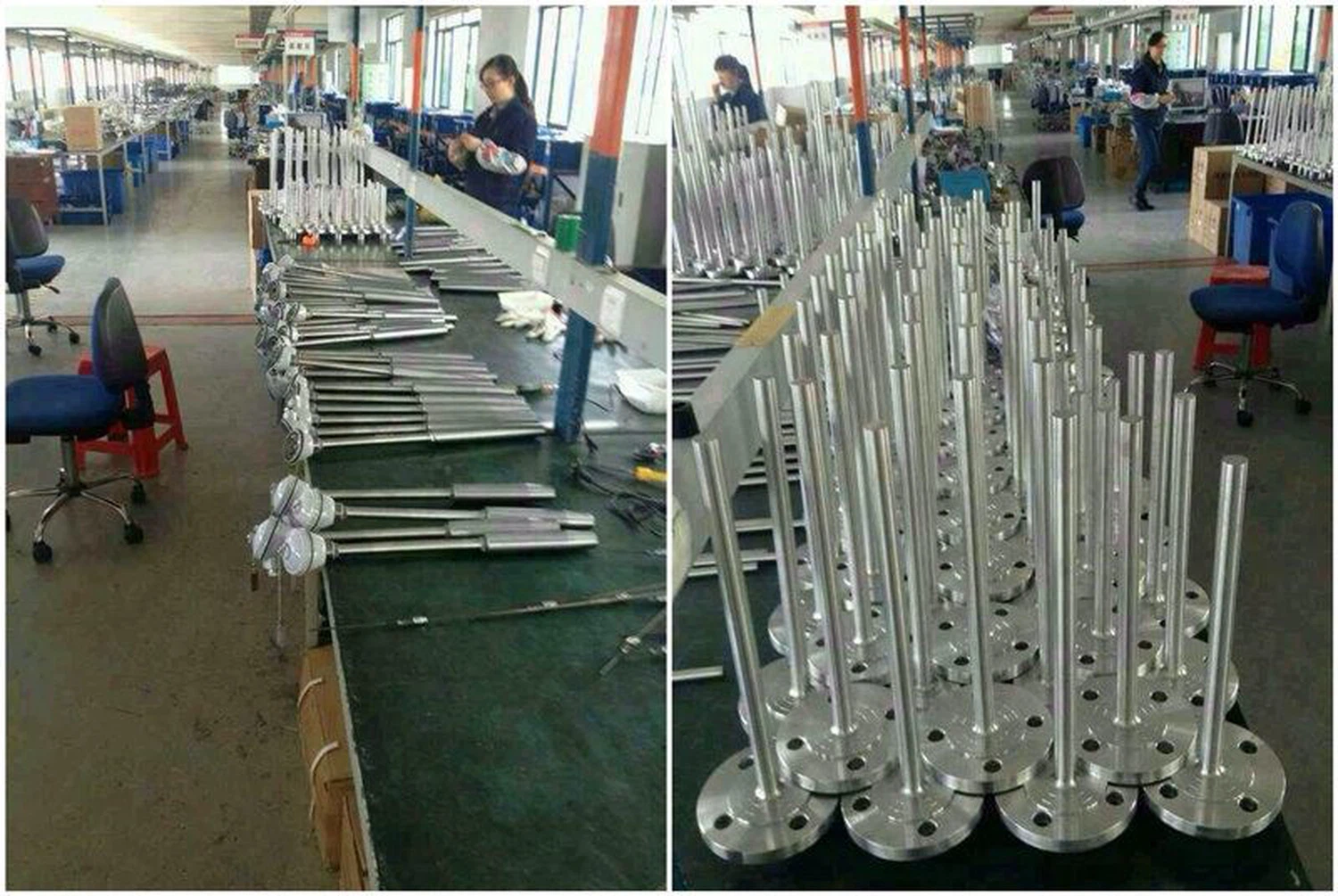
Chongqing Haichen Instrument Co., Ltd. was established in June 2000.After years of independent research and development, Haichen now possesses strong production capacity, larger production scale, advanced testing equipment, professional technical team.Haichen mainly specializes in manufacturing temperature sensors (thermocouple, thermal resistance, bimetallic thermometer, etc.), (signal) isolators, safety barriers, vibration meter and other instruments and meters; also undertakes selection and design, installation and commissioning work for automatic complete sets of instruments and meters.


productcate-1-1


productcate-1-1


Certificate
 
 
productcate-1-1
productcate-1-1
productcate-1-1
productcate-1-1
productcate-1-1


FAQ


Q:What is the difference between thermocouple and RTD?

A: Thermocouples typically have a broader temperature range compared to RTD sensors. If your application involves extreme temperatures, thermocouples might be the preferred choice. RTDs, on the other hand, excel in moderate temperature ranges, providing consistent and reliable readings.

Q:What is difference between RTD and PT100?

A: A PT100 is the most common type of Resistance Temperature Detector (RTD). The PT100 has a resistance of 100 Ohms at 0°C and 138.5 Ohms at 100°C. PT100s are a common choice for measuring temperature in industrial processes and laboratories. They are a popular choice due to their stability, accuracy and repeatability.

Q:What is the difference between a thermistor and a RTD sensor?

A: The main difference between thermistors and RTDs is the material they are made of. Thermistors are typically composed of mixed metal oxides, while RTDs are made of pure metal such as nickel or platinum.R TDs (resistance temperature device) are temperature sensors that are commonly used in a variety of industrial applications including industrial boilers, petrochemical, exhaust gas monitoring and food processing.

Q:Can I replace RTD with thermocouple?

A: Some thermocouples look very similar to an RTD. There are, however, usually some small differences. You usually can't just replace a thermocouple with an RTD without making some changes, such as, reprogramming the controller for a different type of temperature sensor.

Q:Why RTD is better than thermocouple?

A: RTD is more accurate than a thermocouple. Thermocouples have poor accuracy. RTD is very sensitive and can register small changes in temperature. Thermocouples have poor sensitivity, which means that a small change in temperature is not recognised by it.

Q:Is platinum RTD better than thermocouple?

A: In general, thermocouples are better for high-temperature and high-vibration processes, applications that require fast response times, and those with limited space. RTDs offer better accuracy, repeatability, and stability.While both sensor types respond quickly to temperature changes, thermocouples are faster. A grounded thermocouple will respond nearly three times faster than a PT100 RTD. The fastest-possible temperature sensor is an exposed tip thermocouple.

Q: What is the difference between 100 ohm and 1000 ohm RTD?

A: Explanation why the 1K Ohm Platinum RTD is better than the ...
Besides picking up more of the noise signal, the resistance change of the 100Ω RTD is 1/10th the resistance change of the 1KΩ RTD. Therefore the RTD resistance and the noise signal is amplified ten times more in a circuit with a 100Ω RTD than it would be in a circuit with a 1KΩ RTD.

Q:How do I choose a RTD sensor?

A: The temperature sensor selected along with the design depends on the temperature range being measured and the accuracy required. For temperatures in the range of –200°C to +850°C, RTDs provide an excellent combination of high accuracy and good stability.

Q:What is the most common RTD sensor?

A: RTD PT100
The RTD PT100, which is the most commonly used RTD sensor, is made of platinum (PT), and its resistance value at 0°C is 100 O. In contrast, a PT1000 sensor, also made of platinum, has a resistance value of 1000 O at 0°C.

Q:How does a 3 wire RTD work?

A: The 3 wire construction of an RTD is the most common type where on side of the element has one wire connected and the other side has two wire connections. This allows for the extra resistance created in the circuit to be compensated for giving a more accurate reading.Measure the reference probe and determine the temperature. Ideally, you would use a readout designed for temperature work that can measure the resistance and calculate the temperature from calibration coefficients previously entered into the readout.

Q:Do you need special wire for RTD?

A: Thermocouple wire is not required to connect an RTD. Typical RTD cable is standard instrumentation cable in two, three, or four conductors or possibly groups of pairs/triads/quads depending on the type of RTD being used and number of devices being monitored.

Q: What is the most accurate RTD wire?

A: 4-Wire RTD
A 4-wire RTD is the most accurate, complex and expensive. In this configuration, a fourth wire is added to take the exact measurement of the conductors on both sides of the RTD element.

Q:What is the best thermocouple for high temperature?

A: Tungsten-rhenium thermocouples Type C
However, generally speaking, refractory metal tungsten-rhenium thermocouples Type C and Type D are considered the highest temperature thermocouples, capable of being used for temperature measurement up to 2300ºC, provided it is not an oxidizing environment.

Q:What is the most expensive thermocouple?

A: Platinum-based thermocouples tend to be the most stable, but they're also the most expensive. They have a useful temperature range from ambient to around 2,000°C, and short term, much greater (-270°C to 3,000°C).

Q:What is the maximum temperature for platinum RTD?

A: Platinum resistance thermometers (PRTs) offer excellent accuracy over a wide temperature range (from –200 to +850 °C). Standard sensors are are available from many manufacturers with various accuracy specifications and numerous packaging options to suit most applications.

Q:What is the failure rate of RTD sensors?

A: The technical specification for the RTDs specifies a failure rate less than 5 x 10'3 failures/year, or about 3 failures per year per unit.Wire-wound RTDs are especially susceptible to vibration damage. The fine platinum wire used to wind the sensor has a typical diameter of 15 to 35 microns and is quite fragile. A broken or damaged RTD sensor wire may result in: An open circuit.

Q:Does it matter which thermocouple to use?

A: There are different types of thermocouples and their applications may vary. An exposed thermocouple will work best when high response times are required, but an ungrounded thermocouple is better in corrosive environments.

Q: 18.What is the best thermocouple for low temperature?

A: Type T thermocouple
Type T thermocouple is the best thermocouple to measure low temperature. It is very stable thermocouple and is used in extremely low temperature applications such as cryogenics or ultra low freezers. It consist of positive leg made of an Copper wire and negative leg made of Constantan (Cu & Cu-Ni) alloy wire.

Q:Is platinum RTD better than thermocouple?

A: In general, thermocouples are better for high-temperature and high-vibration processes, applications that require fast response times, and those with limited space. RTDs offer better accuracy, repeatability, and stability.These include criteria such as: temperature range, response time, chemical and mechanical resistance and installation location. A thermocouple that is not an optimal match can reduce process efficiency and product quality as well as diminish the accuracy, reliability and long-term performance of the sensor.

Q:Which is more accurate RTD or thermocouple?

A: RTD is more accurate than a thermocouple. Thermocouples have poor accuracy. RTD is very sensitive and can register small changes in temperature. Thermocouples have poor sensitivity, which means that a small change in temperature is not recognised by it.Nickel RTDs are less expensive than platinum and have good corrosion resistance. However, nickel ages more rapidly over time and loses accuracy at higher temperatures.

As one of the most professional rtd sensor suppliers in China for over 20 years, we're featured by good service and competitive price. Please rest assured to buy high quality rtd sensor for sale here from our factory. For customized service, contact us now.

Duplex Thermocouple Type K, rtd transmitter, standard thermocouple connector
goTop

(0/10)

clearall