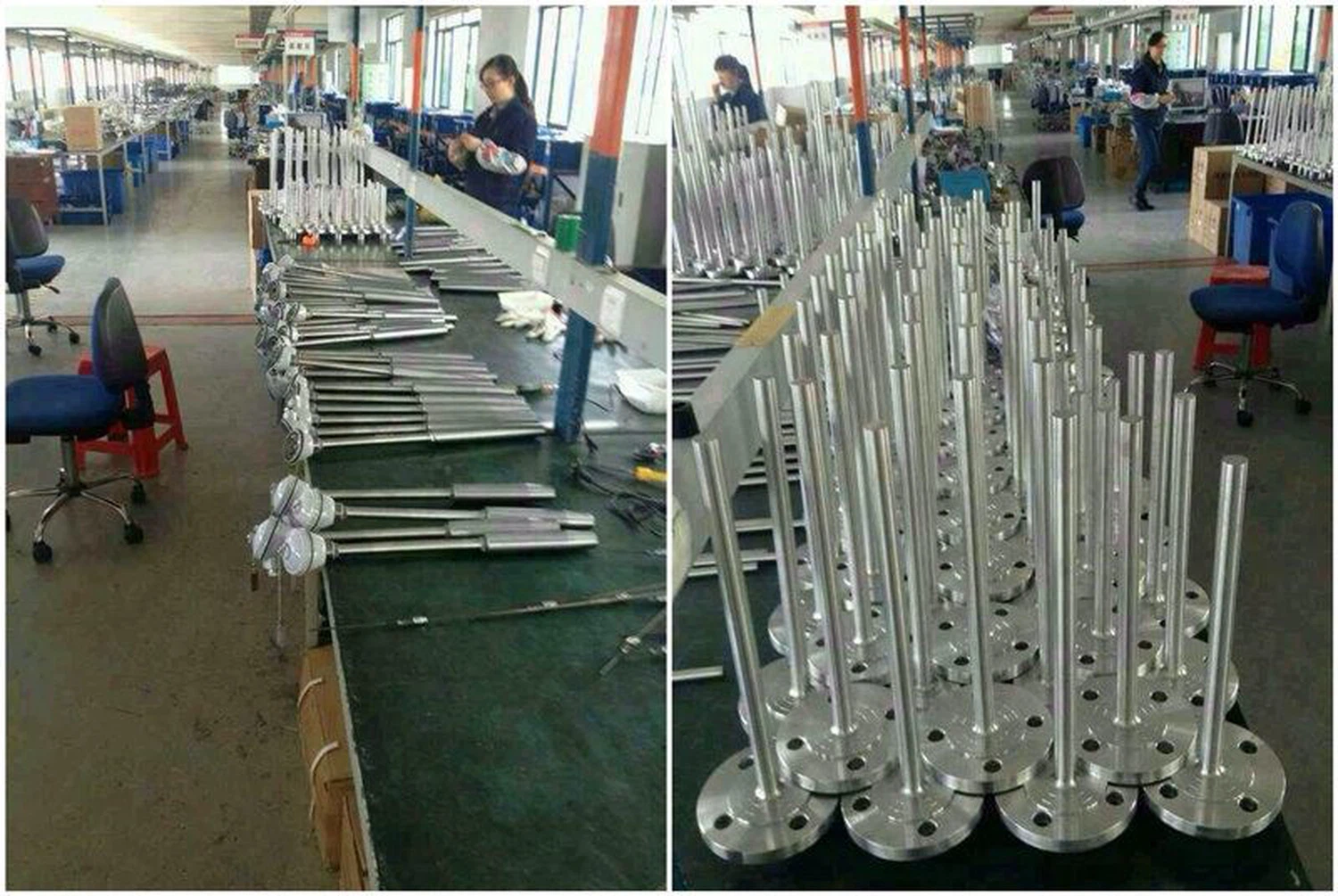
Q: What is the primary difference between RTDs and thermocouples?
A: The main difference between RTDs and thermocouples is the operating principle. RTDs measure temperature by correlating the change in electrical resistance of a pure material, typically platinum, with temperature. In contrast, thermocouples measure temperature using the voltage generated at the junction of two dissimilar metals when exposed to a temperature gradient.
Q: Which temperature sensor is more accurate: an RTD or a thermocouple?
A: Generally, RTDs are more accurate than thermocouples. They offer higher accuracy and stability over a limited temperature range, making them suitable for applications that require precise temperature measurements.
Q: Are thermocouples or RTDs more suitable for high-temperature applications?
A: Thermocouples are more suitable for high-temperature applications, as they can operate over a wider temperature range compared to RTDs. Some thermocouples can measure temperatures up to 2,300°C (4,172°F), whereas RTDs typically have a maximum operating temperature of around 850°C (1,562°F).
Q: Do I need to calibrate my RTD or thermocouple?
A: Both RTDs and thermocouples may require periodic calibration to maintain accuracy and reliability. Calibration techniques vary between the two types of sensors, and the calibration frequency depends on factors such as sensor type, application, and environmental conditions.
Q: What are some common industrial applications for RTDs and thermocouples?
A: RTDs and thermocouples are used in various industries, including petrochemical, power generation, food and beverage, pharmaceutical, and aerospace. Typical applications include process control, equipment monitoring, and safety systems.
Q: What type of wire is thermocouple wire?
A: Type K-This thermocouple uses chromel (90% nickel and 10% chromium) and alumel (95% nickel, 2% aluminum, 2% manganese, 1% silicone) for its wiring. A Type K thermocouple can measure temperatures between -200°C and 1260°C. Type J – This option uses iron and constantan (45% nickel and 55% copper).
Q: What is the difference between Type J and Type K thermocouple wire?
A: Temperature range: J-type thermocouples are suitable for accurate measurements in the range of -210°C to 1200°C, while K-type thermocouples are suitable for accurate measurements in the range of -270°C to 1372°C. Therefore, K-type thermocouples have a wider measurement range.
Q: What is the difference between Type K and Type KX thermocouple wire?
A: KX means that the cable is an extension cable for thermocouples of type K (NiCr-Ni). The insulation of the conductors and the sheaths can be made of a variety of materials. Compensating cable work as an extension cable between a thermocouples of type K and a control unit.
Q: Do thermocouples require special wire?
A: For example, the positive (+) conductor of a type K thermocouple is made of a chromium/nickel alloy called chromel and the negative (-) conductor is made of an aluminum/nickel alloy called alumel. Wire used to make a thermocouple junction is called thermocouple wire.
Q: What color is the J wire on a thermocouple?
A: The most common types are J (black)-, K (yellow)- and T- (blue) type. The wire color indicates what type of thermocouple it is. (example: white + red wire insulations are used for J-type thermocouples; the colors of jacks and plugs for a J-type thermocouple is black.
Q: What is the best thermocouple wire?
A: Type T Thermocouple (Copper/Constantan): The Type T is a very stable thermocouple and is often used in extremely low temperature applications such as cryogenics or ultra low freezers. It is found in other laboratory environments as well. The type T has excellent repeatability between –380F to 392F (–200C to 200C)..
Q: Which is better between J type and K type thermocouple?
A: Due to its oxidation resistance, Type K thermocouple wire outlasts the Type J variant. Moreover, it is a fast-response thermocouple, making it ideal for measuring temperatures on surfaces and in liquids.
Q: What does K stand for in thermocouple?
A: Type K Thermocouple (Nickel-Chromium / Nickel-Alumel): The type K is the most common type of thermocouple. It's inexpensive, accurate, reliable, and has a wide temperature range. The type K is commonly found in nuclear applications because of its relative radiation hardness.
Q: Can you splice Type K thermocouple wire?
A: Can You Splice Thermocouples? When splicing thermocouples into an existing application, keep in mind that: Make sure that you are replacing one thermocouple with a similar Type (example: a Type K for Type K). Make sure that the polarity is maintained (negative wire is red for ANSI/ASTM or White for IEC).
Q: What happens if you wire a thermocouple backwards?
A: This goes for all calibrations. (J, K, E, T, R, S, B, N). Thermocouple Leads Reversed? If the Leads on your thermocouple are reversed, the temperature measured will show to be varying in the opposite direction relative to ambient temperature.
Q: Which wire is positive on a type K thermocouple?
A: In ANSI color coding, the red wire of a thermocouple is negative, and the positive wire is color coded to the type of thermocouple. A type K thermocouple has one red wire and one yellow wire. Type K thermocouples have a useful temperature range of negative 200 to 1,250 degrees Celsius.
Q: Which is positive and negative on thermocouple wire?
A: The insulation on thermocouple wire is color coded for identification. Common guidelines include that the negative lead in insulated thermocouple wire is red. The positive lead has the color of the thermocouple as well as the overall color of insulated extension grade wire.
Q: Can you crimp thermocouple wire?
A: A Thermocouple is Placed in a Hole wide enough to accommo- date the wires with a little clearance. Then the thermocouple is secured in the hole by peening or crimping substrate material near the hole.Due to its oxidation resistance, Type K thermocouple wire outlasts the Type J variant. Moreover, it is a fast-response thermocouple, making it ideal for measuring temperatures on surfaces and in liquids.
Q: What colors are the insulated wires on a Type J thermocouple?
A: For example, in the United States a type J thermocouple has one red wire and one white wire, typically with a brown over jacket. A type J extension grade wire also has one red wire and one white wire, but it has a black over jacket.Generally, RTDs have a slower response time than thermocouples but are more accurate over a wider temperature range. In high-temperature applications, thermocouples tend to have a faster response time, but their accuracy can be affected by electromagnetic interference.
Q: Does it matter which thermocouple to use?
A: There are different types of thermocouples and their applications may vary. An exposed thermocouple will work best when high response times are required, but an ungrounded thermocouple is better in corrosive environments.A beaded wire thermocouple is the simplest form of thermocouple. It consists of two pieces of thermocouple wire joined together with a welded bead. Because the bead of the thermocouple is exposed, there are several application limitations.