Chongqing Haichen Instrument Co., Ltd.

High Temperature Thermocouple

Why Choose Us


Products widely used
Haichen products are safe and reliable, and are widely used in various fields such as steel, petroleum, chemical industry, light industry, building materials, environmental protection, food, power stations, aerospace, ships, etc.


Professional technical team
After years of independent research and development, Haichen now has strong production capacity, large production scale, advanced testing equipment, and a professional technical team.


QC
Strictly tested and inspected before shipment. Organize shipments with long-term freight forwarders, which are reliable and cheap.


Customer service
After shipment, we can notify customers of the tracking number so that customers can track the goods in time. If there are any problems with the product during use, you can contact us at any time by email or phone. We can try to resolve the issue within 24 hours.


What is High Temperature Thermocouple


High temperature thermocouple, also known as thermocouple, is a widely used temperature sensor. It is also used to convert thermal potential difference into electric potential difference as an "electric thermometer". Thermocouples are cheap, easy to replace, do not require an external power supply when measuring, have standard interfaces, and have a large temperature range. The main limitation is accuracy, with systematic errors typically greater than 0.1 degrees Celsius.


  • Tungsten Rhenium Thermocouple

    Tungsten Rhenium Thermocouple

    Tungsten-rhenium thermocouple is a kind of temperature testing products especially developed for

    Add to Inquiry
  • Type S R B Thermocouple

    Type S R B Thermocouple

    S R B type thermocouple is for high temperature testing, mainly used for kiln and furnace. It is

    Add to Inquiry
  • S Type Thermocouple With Plug

    S Type Thermocouple With Plug

    S R B type thermocouple is made of noble metal (platinum in high purity as negative pole, platinum

    Add to Inquiry
  • Small and Laboratory Thermocouples

    Small and Laboratory Thermocouples

    Small platinum-rhodium thermocouple adopts noble metal high purity platinum as the negative pole,

    Add to Inquiry
  • Platinum Rhodium Thermocouple

    Platinum Rhodium Thermocouple

    Platinum-rhodium thermocouple adopts noble metal high purity platinum as the negative pole,

    Add to Inquiry
  • C Type Thermocouple

    C Type Thermocouple

    C Type Thermocouple is a thermocouple with high temperature resistance. It has the advantages of

    Add to Inquiry
  • WRe526 Thermocouple

    WRe526 Thermocouple

    WRe526 Thermocouple is a thermocouple with high temperature resistance. It has the advantages of

    Add to Inquiry
Benefits of High Temperature Thermocouple
 

Wide temperature range

High temperature thermocouples are capable of measuring a wide range of temperatures from -200°c to over 2000°c. This ability to accurately measure extreme temperatures makes them ideal for use in various applications.

Quick response time

High temperature thermocouples offer quick response times to temperature changes, making them ideal for measuring dynamic or fast-changing temperatures. Their fast response times make them suitable for use in industrial applications where temperature changes occur rapidly.

Robust and durable

High temperature thermocouples are designed to be rugged and durable, allowing them to withstand harsh environmental conditions, such as high pressure, moisture, and extreme temperatures. This robustness ensures their longevity, making them an economical and reliable temperature measurement solution.

Easy to install

High temperature thermocouples are easy to install, require minimal maintenance, and can be used in a wide range of applications. They are simple to integrate into process control systems, allowing for easy automation of temperature control processes.

High accuracy

High temperature thermocouples provide high accuracy for temperature measurement, making them ideal for use in situations where precise temperature measurement is essential, such as in laboratories, food processing, and medical settings.

Cost-effective

High temperature thermocouples are an economical temperature measurement solution compared to other temperature sensors, making them a popular choice in various industries.


Types of High Temperature Thermocouple
 

J-Type Thermocouple
J type of thermocouple is formed with Iron and Constantan. 0 to 760 °C is its temperature range. Owing to the low-temperature range of the thermocouple, its life span reduces in high temperatures. J types thermocouple is best suited for vacuum and inert environment. Injection molding is one of the most common applications of such types of the thermocouple. Click here for Data Sheet!


K-Type Thermocouple
Chromel and Alumel form a K-type thermocouple. The temperature range is between 95 and 1260 °C. The neutral or oxidizing environment is best suited for these types of the thermocouple. It generates an EMF variation below 1800°F due to hysteresis, which restricts its use in an inert and oxidizing environment below this temperature. They are most commonly used in refineries. Click here for Data Sheet!


N-Type Thermocouple
This thermocouple is a combination of alloys Nicrosil and Nisil. The temperature range is between 650 to 1260 °C. Unlike K-type thermocouples, the N-type thermocouple offers very high resistance for degradation due to green rot and hysteresis. They are most commonly used in refineries and petrochemical industries. Click here for Data Sheet!


R-Type Thermocouple
A combination of Platinum (13% Rhodium) and Platinum forms R type thermocouple. The temperature range is between 870 to 1450 °C. It is costlier than S type thermocouple as it contains a higher percentage of Rhodium. Its high accuracy and stability make it an ideal thermocouple to used in Sulfur recovery units. Click here for Data Sheet!


S-Type Thermocouple
It is a combination of Platinum (10% Rhodium) and Platinum. The temperature range is between 980 to 1450 °C. S type thermocouple is used in applications involving very high temperatures. This type is widely used across various l industries. Click here for Data Sheet!


T-Type Thermocouple
It is formed with Copper and Constantan. The temperature range is between -200 to 370°C. This type of thermocouple is suitable for the inert atmosphere as well as the vacuum. They are widely used as they generally resist decomposition even in a moist environment. They are commonly used in food production and cryogenics. Click here for Data Sheet!


Application of High Temperature Thermocouple
 
Thermocouples for Oil & Gas Industry

Oil and gas production is heavy-duty work for man and machine, which takes place under extreme conditions like enormous forces, massive vibrations and explosive gases. The oil/gas industry has several critical requirements to the process in order to prevent moisture, overheating, corrosion, and inefficient fuel usage. Some important and largely produced petrochemicals are ethylene, propylene, benzene, methanol etc. Cracking furnace, reactors, reformers, vessels, tanks are engaged in producing these Petrochemicals. Temperature measurement and control are very important and critical in petrochemical processing. Gases & liquids flow at high velocity & pressure and many of them have corrosion & erosion properties. Petrochemicals are highly Flammable. Therefore, Hazardous area protection is essential.

Thermocouples for the food and beverage industry

There are multiple applications for thermocouples in the food and beverage industry, such as pasteurisation, refrigeration, fermentation, brewing, and bottling. You don't have to worry when using a thermocouple temperature sensor because it offers accurate temperature readings for frying and cooking to ensure your food is well-cooked.Restaurant appliances like grills, toasters, fryers, warmers, and ovens often use thermocouples. Also, you're likely to find thermocouples in the form of temperature-sensing probes in cooking equipment used in large-scale food processing operations.

Thermocouples for molten metal

Coming up with an accurate temperature measurement for molten metals like steel, zinc, and aluminum can be challenging because of the extremely high temperatures involved. The temperature sensors widely used for molten metals are Types B, S, and R platinum thermocouples and Type K and N base metal thermocouples. Choosing the ideal type would depend on the temperature range of your specific metal-related application.Base metal thermocouples normally use #8 or #14 American wire gauge (AWG) with metal protection tubes and ceramic insulators. On the other hand, platinum thermocouples often use diametres ranging from #20 to #30 AWG.

Thermocouples for the plastic industry

Manufacturing plastic products needs precise temperature control. Thermocouples are usually required in various areas for temperature monitoring during plastic processing. They're used to measure the melting or surface temperature in diecasting molds and injection.Before you use thermocouples in plastic processing, you must know that thermocouples in the plastic industry are categorised into two. The first category involves measurement. Here, you can use the thermocouple to determine the transfer of plastic heat function depending on their cross-section. Remember, the thermocouple must determine the applied force dissimilarity, primarily for its velocity and orientation.

 
Components of High Temperature Thermocouple
 
 
Thermoelements

These are the two dissimilar metal wires that are joined together at one end to form the measuring junction of the thermocouple. The thermoelements generate a voltage that is proportional to the temperature difference between the hot and cold junctions.

 
Protective sheath

This is an optional component that encloses the thermoelements and protects them from the environment. The sheath can be made of a variety of materials depending on the application, such as stainless steel, Inconel, or ceramic.

 
Connection head

This is the enclosure that connects the thermocouple to the instrumentation. It is usually made of aluminum or cast iron and provides a terminal block for connecting the thermocouple wires to the instrumentation wires.

 
Extension wires

These are the wires that connect the thermocouple to the measuring instrument. The wires are made of the same materials as the thermocouple thermoelements but can be less expensive and less accurate than the thermocouple itself.

 
Measuring instrument

This is the device that measures the voltage generated by the thermocouple and converts it into a temperature reading. The measuring instrument can be a digital multimeter, a temperature controller, or a data logger, depending on the application.


How to Choose High Temperature Thermocouple
Type S R B Thermocouple
Tungsten Rhenium Thermocouple
S Type Thermocouple With Plug
Small and Laboratory Thermocouples

Temperature range
The temperature range of the application will determine which types of high temperature thermocouples are suitable. For example, type k high temperature thermocouples can measure temperatures up to 1,200°c, while type s high temperature thermocouples can measure temperatures up to 1,600°c.


Environmental conditions
The environment in which the high temperature thermocouple will be used is also an important consideration. For example, if the high temperature thermocouple will be exposed to corrosive materials or moisture, a high temperature thermocouple with a protective sheath may be needed.


Accuracy requirements
The level of accuracy required for the application will also determine which type of high temperature thermocouple is suitable. For applications that require high accuracy, a type r or type s thermocouple may be necessary.


Response time
The response time of the high temperature thermocouple is important in applications where temperature changes rapidly. For example, a fast-responding high temperature thermocouple may be necessary for a furnace where the temperature changes quickly.


Cost
The cost of the high temperature thermocouple is also an important consideration. Some types of thermocouples are more expensive than others, so the cost must be balanced against the other factors when selecting a High Temperature thermocouple for a specific application.


Design Codes and Standards for High Temperature Thermocouples
 

ASTM E230-03

This standard specifies the tolerances for thermocouple wires, which are used to manufacture thermocouples.

ASTM E1129

This standard provides guidelines for the calibration of thermocouples, including methods for determining the temperature-emf relationship and the uncertainty associated with the calibration process.

ANSI/ISA-51.1

This standard provides guidelines for the selection, installation, and use of thermocouples in industrial applications.

IEC 60584

This standard provides guidelines for the selection, installation, and use of thermocouples in a variety of applications.

ASME PTC 19.3 TW

This standard provides guidelines for the use of thermocouples in power plant applications, including design, installation, and calibration.

NIST SP 250-23

This standard provides guidelines for the calibration of thermocouples using fixed-point cells and interpolation techniques.


Things to Note About High Temperature Thermocouples
 
01/

Polarity
Each high temperature thermocouple has a positive and a negative lead. If you hook it up with the reverse polarity, you will experience unpredictable readings and incorrect temperatures. Always make sure proper polarity is maintained at each junction and connector along your thermocouple.

02/

Interference
When measuring from a high temperature thermocouple, each high temperature thermocouple is compared to adapter's internal ground. If your high temperature thermocouple is measuring a conductive device which cannot equalize to the ground of the adapter, you should isolate the high temperature thermocouple wire using thermally conductive epoxy. High temperature thermocouples are conductive, and are very good at shorting electrical systems together. If in doubt, do not allow the high temperature thermocouple wire to contact other metal parts.

03/

Wire size
The maximum temperature varies with the diameter of the wire used in the high temperature thermocouple. Although the type of thermocouple dictates the temperature range, the maximum range is also limited by the diameter of the high temperature thermocouple wire. That is, a very thin high temperature thermocouple may not reach the full temperature range. On the other hand, a thinner thermocouple does reduce the amount of thermal distortion introduced.selecting the wire gauge used in the high temperature thermocouple sensor depends upon your application. Generally, when longer life is required for the higher temperatures, the larger size gauges should be chosen. When sensitivity is the prime concern, the smaller sizes should be used.

04/

Wire length
Very long high temperature thermocouples are okay (even 100m), but if there are measurement stability issues or usb resets, ferrite beads can be added to the high temperature thermocouple wire close to the adapter. See our tutorial on improving hardware reliability for more information.note that high temperature thermocouples use special wires. This means that if you want to extend the length of your high temperature thermocouple you need to use high temperature thermocouple wire of the same letter type, not just generic wire. Often, high temperature thermocouple extension wire will be rated for a narrower temperature range, since it isn't intended to be used in the sensing end of the application.


How to connect your High Temperature Thermocouple


Stripped Wire

Most thermocouples come with the leads just stripped and otherwise unaltered. We recommend a 5 to 6mm wire strip length; the terminal blocks on the majority of adapters will accept wires between 16 - 26 AWG. When using thin wires, make sure that you have a solid connection after tightening the terminal screw.

Connectors

Many K-Type thermocouples are designed to mate with the Subminiature (flat pin) female connector. Listed below are examples of compatible thermocouples from popular sensor manufacturers using this connector.

C Type Thermocouple
High Temperature Thermocouple Cleaning Process
 

Turn off the power to the device where the thigh temperature hermocouple is installed to avoid any accidents.


Locate the high temperature thermocouple within the equipment – it is usually a small metal rod protruding into the area you are monitoring.


Use a soft brush or compressed air to gently remove any dust or debris that has accumulated on the high temperature thermocouple. Be careful not to apply too much pressure to avoid damaging the sensitive components.


If there is corrosion on the high temperature thermocouple, you can carefully use a fine abrasive material, such as sandpaper or a wire brush, to gently remove it. Be sure to clean the thermocouple thoroughly afterward to remove any residue.


Once the high temperature thermocouple is clean, inspect it for any signs of damage or wear. If you notice any issues, it may be time to replace the thermocouple.


After cleaning and inspecting the high temperature thermocouple, reassemble the equipment and turn the power back on. Check the temperature readings to ensure that the thermocouple is now functioning properly.


Our Factory
 

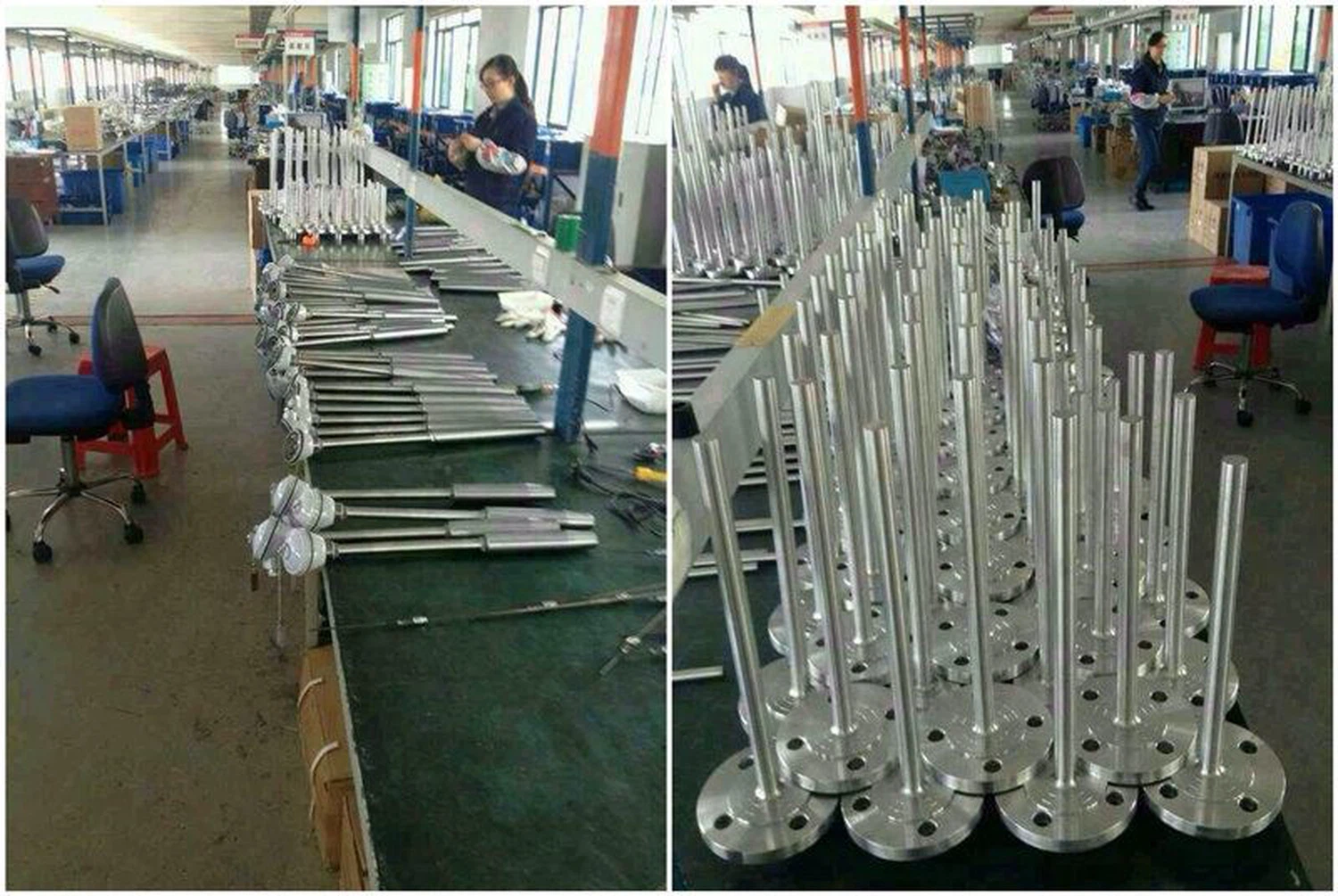
Chongqing Haichen Instrument Co., Ltd. was established in June 2000.After years of independent research and development, Haichen now possesses strong production capacity, larger production scale, advanced testing equipment, professional technical team.Haichen mainly specializes in manufacturing temperature sensors (thermocouple, thermal resistance, bimetallic thermometer, etc.), (signal) isolators, safety barriers, vibration meter and other instruments and meters; also undertakes selection and design, installation and commissioning work for automatic complete sets of instruments and meters.


productcate-1-1


productcate-1-1


Certificate
 
 
productcate-1-1
productcate-1-1
productcate-1-1
productcate-1-1
productcate-1-1


FAQ


Q: What is the best thermocouple for high temperature?

A: However, generally speaking, refractory metal tungsten-rhenium thermocouples Type C and Type D are considered the highest temperature thermocouples, capable of being used for temperature measurement up to 2300ºC, provided it is not an oxidizing environment.

Q: What is the maximum temperature for a Type K thermocouple?

A: Type K thermocouples have a general temperature range of -200 to 1260°C (-326 to 2300°F), however there are some caveats to this: If used for temperatures below 0°C special material is needed in order to meet the specified accuracies.

Q: What is the temperature range of a thermocouple?

A: What temperature range are thermocouples suitable for? This is very much dependent on type but the overall range for all thermocouple types is -200°C to +1800°C. There are many factors to consider when selecting a thermocouple type for an application and we would be happy to offer assistance where possible.

Q: What is the maximum temperature of a Type T thermocouple?

A: Temperature Range: The different thermocouple types have different temperature ranges. For example, Type T with its Copper leg has a max temperature of 370C or 700F. Type K on the other hand can be used up to 1260C or 2300F.

Q: How do I know which thermocouple to buy?

A: These include criteria such as: temperature range, response time, chemical and mechanical resistance and installation location. A thermocouple that is not an optimal match can reduce process efficiency and product quality as well as diminish the accuracy, reliability and long-term performance of the sensor.

Q: Does it matter what thermocouple you use?

A: Because a thermocouple can take many shapes and forms, it is important to understand how to correctly select the right sensor. The most commonly criteria used to make that choice are the temperature range, the chemical resistance, the abrasion and vibration resistance and the installation requirements.

Q: Which is better RTD or Type K thermocouple?

A: Generally, RTDs have a slower response time than thermocouples but are more accurate over a wider temperature range. In high-temperature applications, thermocouples tend to have a faster response time, but their accuracy can be affected by electromagnetic interference.Due to its oxidation resistance, Type K thermocouple wire outlasts the Type J variant. Moreover, it is a fast-response thermocouple, making it ideal for measuring temperatures on surfaces and in liquids.

Q: How to make your own thermocouple?

A: A basic thermocouple is manufactured by striping thermocouple wire which consists of a pair of wires, strip away the insulation and shielding and trim the bare wire, twist the striped bare wires together trim the two ends. Solder wires together ensuring they maintain good contact.

Q: What is the difference between a thermopile and thermocouple?

A: Thermocouples are commonly used as safety devices for appliances to prevent overheating, gas leaks or fires. Thermopiles are typically used in situations that require greater sensitivity and accuracy, such as detecting HVAC system leaks.A thermocouple is a sensor for measuring temperature. This sensor consists of two dissimilar metal wires, joined at one end, and connected to a thermocouple thermometer or other thermocouple-capable device at the other end.

Q: What is the most accurate thermocouple type?

A: Type T can withstand most chemical atmospheres, but can also measure extremely low temperatures with greater accuracy. These thermocouples are often suitable for the food industry where the process temperatures are well below zero and accurate measurements are crucial to product safety.

Q: What is the most popular thermocouple?

A: Type K Thermocouple
Type K Thermocouple (Nickel-Chromium / Nickel-Alumel): The type K is the most common type of thermocouple. It's inexpensive, accurate, reliable, and has a wide temperature range. Temperature Range: Thermocouple grade wire, –454 to 2,300F (–270 to 1260C)

Q: Can I replace my own thermocouple?

A: Replacing a thermocouple is a relatively easy fix that can take less than two hours. This guide reviews how to replace a thermocouple to ensure gas appliances stay in good working order, as well as how to relight a pilot light.Type J thermocouple is a very common and general purpose thermocouple. It has smaller temperature range and a shorter lifespan at higher temperatures. It consist of positive leg made of an Iron wire and negative leg made of an Constantan ( Copper-Nickel ) alloy wire.

Q: What is the difference between J type and T type thermocouple?

A: K Type- Known as a general purpose thermocoupole due to its low cost and temperature range. J Type- Well suited for oxidizing atmospheres. T Type- Well suited for oxidizing atmospheres. E Type- In oxidizing or inert atmospheres the operating range is roughly -418F to 1,625F (-250C to 900C).

Q: What is type K thermocouple?

A: Type K Thermocouple provides widest operating temperature range. It consist of positive leg which is non-magnetic and negative leg which is magnetic.In K Type Thermocouple traditional base metal is used due to which it can work at high temperature and can provide widest operating temperature range.

Q: How do you know if your thermocouple is bad?

A: The first step in diagnosing a faulty thermocouple is a visual inspection. Next, look for signs of physical damage, like fraying, corrosion, or discoloration. Next, perform a basic "touch test" to see if the thermocouple is significantly colder or hotter than it should be.

Q: How do I know if my thermocouple is J or K?

A: A type K thermocouple has one red wire and one yellow wire. Type K thermocouples have a useful temperature range of negative 200 to 1,250 degrees Celsius. A type J thermocouple has one red wire and one white wire. Type J thermocouples have a useful temperature range of 0 to 750 degrees Celsius.

Q: Are J and K thermocouples interchangeable?

A: Type J cable is your best bet in lower temperatures, as its temperature range starts at -40°C. It is also perfect for vacuum applications. In all other applications that do not specifically match these criteria, both Type K and Type J thermocouple wire can be used as long as their temperature range is met.

Q: What stops a thermocouple from working?

A: Changes in temperature can cause regular expansion and contraction in metal, which will cause thermocouples to weaken over time. After enough time, metal fatigue can cause a thermocouple to break.Type K Thermocouple (Nickel-Chromium / Nickel-Alumel): The type K is the most common type of thermocouple. It's inexpensive, accurate, reliable, and has a wide temperature range.

Q: How many millivolts does a good thermocouple produce?

A: 25 to 35 millivolts
The normal millivolt output is 25 to 35 millivolts; on some, you may even get up to 35. The other part of this safety pilot system is the electromagnet (power unit).High pressure can cause overheating and shorten the life of thermopiles and thermocouples. Manifold Pressure Reading This is the pressure taken while the unit is burning on high.

Q: Do thermocouples go bad?

A: Like the other component parts in your furnace, the thermocouple can wear down over time, producing lower voltage than it should when heated. And the worst part is that you can have a bad thermocouple without even knowing. Therefore, inspecting and testing your thermocouple should be part of your furnace maintenance.

As one of the most professional high temperature thermocouple suppliers in China for over 20 years, we're featured by good service and competitive price. Please rest assured to buy high quality high temperature thermocouple for sale here from our factory. For customized service, contact us now.

thermocouple potentiometer, cht thermocouple, ungrounded thermocouple
goTop

(0/10)

clearall