

Hey there! As a supplier of Sanitary RTD Probes, I often get asked about the frequency response of these nifty little devices. So, let's dive right in and break it down in a way that's easy to understand.
First off, what's an RTD probe? Well, an RTD (Resistance Temperature Detector) is a sensor that measures temperature by correlating the resistance of the RTD element with temperature. A Sanitary RTD Probe, specifically, is designed for applications where hygiene is a top priority, like in the food and beverage, pharmaceutical, and dairy industries.

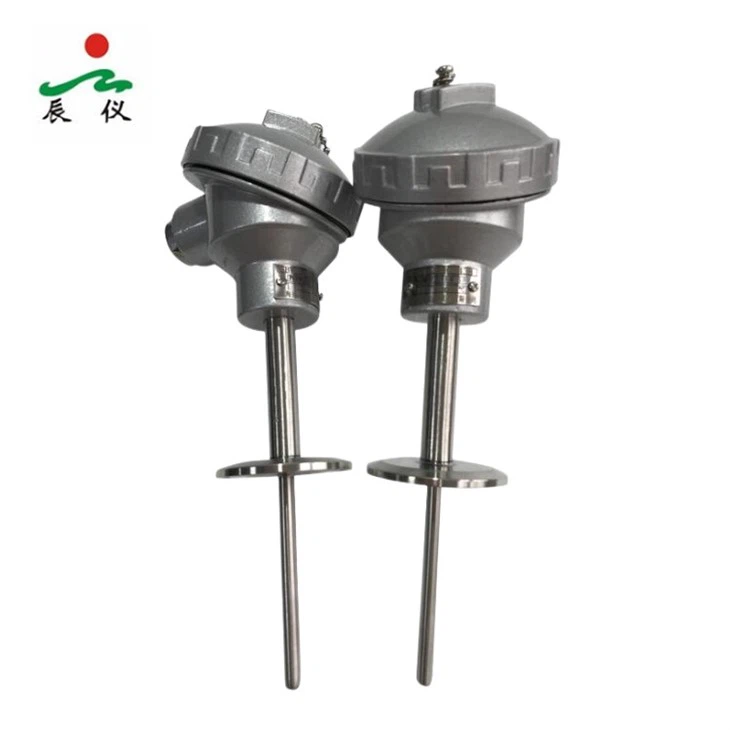
Now, onto the frequency response. Frequency response refers to how well a sensor can track changes in the measured variable over time. In the case of a Sanitary RTD Probe, it's about how quickly and accurately the probe can respond to changes in temperature.
The frequency response of a Sanitary RTD Probe is influenced by several factors. One of the main factors is the thermal mass of the probe. Thermal mass is basically the amount of heat energy required to change the temperature of the probe. A probe with a high thermal mass will take longer to heat up or cool down, which means it will have a slower frequency response. On the other hand, a probe with a low thermal mass can respond more quickly to temperature changes.
Another factor is the construction of the probe. The way the RTD element is packaged and the materials used can affect how heat is transferred to the element. For example, a probe with a thin, highly conductive sheath will transfer heat more efficiently than one with a thick, insulating sheath. This can result in a faster frequency response.
The type of RTD element also plays a role. There are different types of RTD elements, such as Pt100 Platinum Temperature Sensors Pt100 Platinum Temperature Sensors. These elements have different characteristics that can impact the frequency response. Pt100 sensors are quite popular because they offer good accuracy and stability over a wide temperature range.
Let's talk about why frequency response matters. In many industrial processes, temperature can change rapidly. For instance, in a food processing plant, a batch of product might be quickly heated or cooled during different stages of production. If the Sanitary RTD Probe can't keep up with these rapid temperature changes, it can lead to inaccurate temperature measurements. This, in turn, can affect the quality and safety of the final product.
To measure the frequency response of a Sanitary RTD Probe, we typically use a step response test. In this test, we suddenly change the temperature around the probe and then measure how long it takes for the probe to reach a certain percentage (usually 63.2%) of the final temperature. This time is called the time constant, and it's a key parameter for describing the frequency response. A shorter time constant means a faster frequency response.
However, it's important to note that a faster frequency response isn't always better. Sometimes, a slower response can be beneficial. For example, in applications where there are a lot of temperature fluctuations that are just noise and not important for the process, a probe with a slower frequency response can act as a filter and give a more stable reading.
As a supplier of Sanitary RTD Probes Sanitary RTD Probe, we understand the importance of getting the right frequency response for your specific application. That's why we offer a range of probes with different designs and specifications. Whether you need a probe with a fast response for a high - speed process or a more stable one for a noisy environment, we've got you covered.
Our WZP Pt100 Temperature Sensors WZP Pt100 Temperature Sensor are a great option for many applications. They are known for their reliability and accuracy, and we can customize them to meet your specific frequency response requirements.
When you're choosing a Sanitary RTD Probe, it's crucial to consider the frequency response in the context of your overall process. Think about how quickly the temperature changes in your application, the level of accuracy you need, and any environmental factors that might affect the probe.
If you're still not sure which probe is right for you, don't worry! Our team of experts is here to help. We can work with you to understand your needs and recommend the best Sanitary RTD Probe for your situation.
So, if you're in the market for a Sanitary RTD Probe and want to ensure you're getting the right frequency response, reach out to us. We're eager to have a chat with you about your requirements and start a productive conversation about how we can meet your temperature sensing needs.
References
- "Temperature Measurement Handbook" - A comprehensive guide on temperature sensors and their characteristics.
- Industry standards and guidelines related to RTD sensors in sanitary applications.
