

Emissivity is a critical concept in the field of thermal measurement, especially when dealing with temperature sensors like the Sanitary RTD Probe. As a trusted supplier of Sanitary RTD Probes, we understand the importance of this parameter and its implications for accurate temperature measurement. In this blog, we will delve into what emissivity is, its significance for Sanitary RTD Probes, and how it affects the performance of these sensors.
Understanding Emissivity
Emissivity is a measure of how efficiently a material emits thermal radiation compared to a perfect emitter, known as a blackbody. A blackbody has an emissivity of 1, meaning it emits radiation at the maximum possible rate for a given temperature. Real - world materials, on the other hand, have emissivities between 0 and 1.
The emissivity of a material depends on several factors, including its surface finish, material composition, and temperature. For example, polished metals typically have low emissivities (close to 0), while non - metallic materials such as ceramics and painted surfaces often have higher emissivities (closer to 1).
Mathematically, the power radiated by a body can be described by the Stefan - Boltzmann law:
$P=\epsilon\sigma AT^{4}$
where $P$ is the power radiated, $\epsilon$ is the emissivity of the body, $\sigma$ is the Stefan - Boltzmann constant ($\sigma = 5.67\times10^{-8}\ W/(m^{2}K^{4})$), $A$ is the surface area of the body, and $T$ is the absolute temperature of the body.
Emissivity and Sanitary RTD Probes
Sanitary RTD Probes, such as the ones we supply at Sanitary RTD Probe, are designed for use in hygienic applications, such as food and beverage processing, pharmaceutical manufacturing, and biotechnology. These probes are typically made of materials like stainless steel, which is known for its corrosion resistance and ease of cleaning.
The emissivity of a Sanitary RTD Probe is an important consideration because it can affect the accuracy of temperature measurement. When a probe is exposed to a thermal environment, it not only senses the temperature of the medium it is in contact with but also exchanges thermal radiation with its surroundings. If the emissivity of the probe is not accurately accounted for, this radiation exchange can lead to errors in temperature measurement.
For example, if a Sanitary RTD Probe has a lower emissivity than expected, it may absorb less thermal radiation from its surroundings. This can result in the probe reading a lower temperature than the actual temperature of the medium. Conversely, if the emissivity is higher than expected, the probe may absorb more radiation and read a higher temperature.
Factors Affecting the Emissivity of Sanitary RTD Probes
Surface Finish
The surface finish of a Sanitary RTD Probe has a significant impact on its emissivity. A polished stainless - steel surface will have a lower emissivity compared to a rough or matte surface. This is because a polished surface reflects more of the incident radiation, while a rough surface absorbs more.
In hygienic applications, a smooth surface is often preferred to prevent the accumulation of contaminants. However, this smooth surface may also result in a lower emissivity, which needs to be considered when calibrating the probe for accurate temperature measurement.
Material Composition
The material composition of the probe also affects its emissivity. Different grades of stainless steel may have slightly different emissivities due to variations in their chemical composition. Additionally, if the probe has a coating or a layer of insulation, this can also change its emissivity.

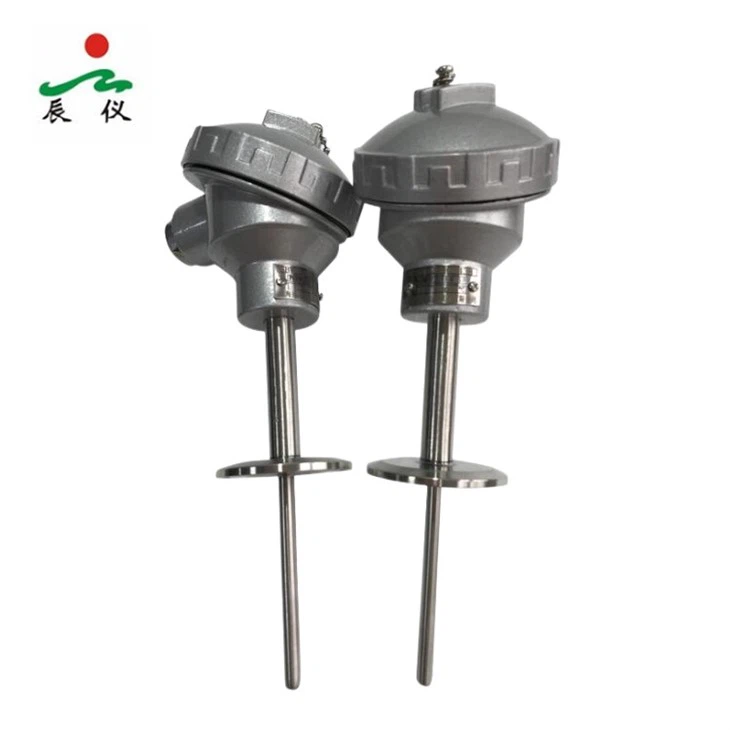
For instance, some Sanitary RTD Probes may be coated with a thin layer of a non - metallic material to improve their corrosion resistance or to enhance their hygienic properties. This coating can increase the emissivity of the probe, which should be taken into account during the calibration process.
Temperature
The emissivity of a material can also vary with temperature. In general, the emissivity of most materials increases with increasing temperature. This temperature - dependence needs to be considered when using Sanitary RTD Probes in applications where the temperature can vary significantly.
Measuring the Emissivity of Sanitary RTD Probes
Measuring the emissivity of a Sanitary RTD Probe can be a challenging task. One common method is to use an emissivity meter, which measures the ratio of the radiation emitted by the probe to the radiation emitted by a blackbody at the same temperature.
Another approach is to use a comparison method, where the probe is placed in a controlled thermal environment along with a reference sensor of known emissivity. By comparing the temperature readings of the two sensors, the emissivity of the probe can be estimated.
It is important to note that emissivity measurement is not always straightforward, and it may require specialized equipment and expertise. As a supplier of Sanitary RTD Probes, we work closely with our customers to ensure that the emissivity of our probes is accurately characterized and accounted for in their applications.
Impact on Temperature Measurement Accuracy
The emissivity of a Sanitary RTD Probe can have a significant impact on the accuracy of temperature measurement. In applications where precise temperature control is crucial, such as in the production of pharmaceuticals or the brewing of beer, even small errors in temperature measurement can have serious consequences.
To minimize the impact of emissivity on temperature measurement accuracy, it is important to calibrate the probe correctly. Calibration involves adjusting the probe's output to account for its emissivity and other factors that may affect its performance.
In addition to calibration, proper installation and maintenance of the probe are also essential. For example, the probe should be installed in a way that minimizes its exposure to external radiation sources, such as hot surfaces or direct sunlight. Regular cleaning and inspection of the probe can also help to ensure that its surface properties, and therefore its emissivity, remain stable over time.
Complementary Products and Emissivity
Our product range includes Pt100 Platinum Temperature Sensors and Pt1000 Resistance Temperature Detector, which are often used in conjunction with Sanitary RTD Probes. These sensors also have their own emissivity characteristics, which need to be considered when designing a temperature measurement system.
The emissivity of Pt100 and Pt1000 sensors can affect their performance in a similar way as it does for Sanitary RTD Probes. By understanding the emissivity of all the components in a temperature measurement system, we can ensure that the overall system provides accurate and reliable temperature measurements.
Conclusion
In conclusion, the emissivity of a Sanitary RTD Probe is a crucial parameter that can significantly affect the accuracy of temperature measurement. As a supplier of these probes, we are committed to providing our customers with high - quality products and the technical support they need to ensure accurate temperature measurement in their applications.
Understanding the factors that affect the emissivity of Sanitary RTD Probes, such as surface finish, material composition, and temperature, is essential for proper calibration and use of these sensors. By carefully considering these factors and using appropriate measurement and calibration techniques, we can minimize the errors caused by emissivity and ensure the reliability of temperature measurement systems.
If you are in the market for Sanitary RTD Probes or need more information about emissivity and its impact on temperature measurement, we invite you to contact us for a detailed discussion. Our team of experts is ready to assist you in selecting the right products for your specific needs and to provide you with the necessary support for successful implementation.
References
- Incropera, F. P., & DeWitt, D. P. (2002). Fundamentals of Heat and Mass Transfer. Wiley.
- Mahan, J. R. (2002). Thermal Radiation Heat Transfer. Taylor & Francis.
- ASTM E408 - 17. Standard Test Method for Total Normal Emittance of Surfaces Using Inspection - Type Radiometers.
