

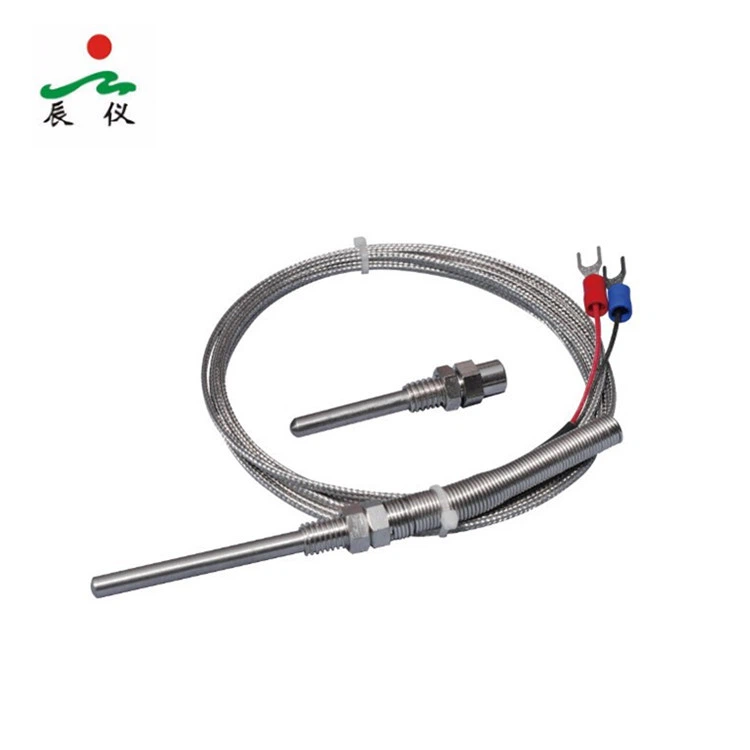
The hysteresis of a thermocouple is a crucial concept that can significantly impact its performance and accuracy in temperature measurement. As a supplier of M5 Thermocouples, understanding and communicating about this phenomenon is essential for our customers to make informed decisions. In this blog, we'll delve into what hysteresis is in the context of M5 Thermocouples, how it affects their use, and what factors contribute to it.
What is Hysteresis?
In general scientific terms, hysteresis refers to the phenomenon where the output of a system depends not only on its current input but also on its past input history. In the case of thermocouples, hysteresis is the difference in the thermoelectric voltage output for the same temperature depending on whether the temperature is increasing or decreasing. When a thermocouple is exposed to a temperature change, the voltage it generates does not always follow a perfectly reversible path.
For an M5 Thermocouple, this means that if we heat the thermocouple to a certain temperature and then cool it back down to the same temperature, the voltage output may not be exactly the same as it was during the heating process. This discrepancy can lead to inaccuracies in temperature measurement, especially in applications where precise and consistent readings are required.
Impact on Temperature Measurement
The hysteresis of an M5 Thermocouple can have several implications for temperature measurement. In industrial processes where temperature control is critical, such as in chemical reactions or heat treatment of metals, inaccurate temperature readings due to hysteresis can lead to sub - optimal results. For instance, if the thermocouple over - or under - estimates the temperature during a heat treatment process, it can affect the mechanical properties of the metal being treated, potentially leading to product failures.
In laboratory settings, where research relies on accurate temperature data, hysteresis can introduce errors in experimental results. Scientists may base their conclusions on incorrect temperature information, which can have far - reaching consequences for the validity of their research.
Factors Contributing to Hysteresis in M5 Thermocouples
Material Properties
The materials used in the construction of an M5 Thermocouple play a significant role in its hysteresis characteristics. Different thermoelectric materials have different atomic structures and chemical properties. When exposed to temperature changes, these materials expand and contract, and the internal stress and strain developed during these processes can cause hysteresis. For example, if the metal alloys used in the thermocouple wires have a non - uniform crystal structure, the movement of atoms during temperature changes may not be fully reversible, leading to differences in voltage output.
Temperature Cycling
The frequency and range of temperature cycling also impact hysteresis. If an M5 Thermocouple is subjected to rapid and large - amplitude temperature fluctuations, the internal structure of the thermoelectric materials can be more severely affected. Each temperature cycle can cause micro - structural changes in the wires, such as the formation of dislocations and grain boundary movements. Over time, these changes accumulate, resulting in increased hysteresis.
Mechanical Stress
Mechanical stress on the thermocouple wires can also contribute to hysteresis. During installation or operation, the wires may be bent, twisted, or compressed. This mechanical deformation can introduce internal stress in the materials, which can interact with the thermal stress caused by temperature changes. The combined effect of mechanical and thermal stress can disrupt the normal thermoelectric behavior of the M5 Thermocouple and lead to hysteresis.

Minimizing Hysteresis in M5 Thermocouples
As a supplier, we understand the importance of minimizing hysteresis in our M5 Thermocouples to provide our customers with accurate temperature measurement solutions. One approach is to carefully select high - quality thermoelectric materials with stable micro - structures. By using materials with low internal stress and good thermal stability, we can reduce the likelihood of hysteresis.
We also recommend proper installation and handling of the thermocouples to avoid mechanical stress. This includes ensuring that the wires are not bent or twisted during installation and that the thermocouple is protected from external mechanical forces during operation.
In addition, for applications where high - precision temperature measurement is required, we may suggest using calibration techniques to compensate for hysteresis. Regular calibration can help to correct the temperature readings based on the known hysteresis characteristics of the thermocouple.
Related Products
If you are interested in other types of thermocouples, we also offer a variety of related products. You can check out our K Type Multipoint Thermocouple, K Type Thermocouple Probe, and Duplex Thermocouple Type K. These products are designed to meet different temperature measurement needs in various industries.
Contact for Purchase and Discussion
We are always ready to provide more detailed information about our M5 Thermocouples and how to address hysteresis issues in your specific applications. If you have any questions regarding the M5 Thermocouple or are interested in purchasing our products, feel free to reach out and start a discussion. We can help you select the most suitable thermocouple for your needs and ensure that you get accurate and reliable temperature measurement results.
References
- R. P. Reed, "Thermocouple Technology and Applications", CRC Press, 2008.
- B. W. Mangum, "Thermocouple Thermometry: Theory, Practice, and Advice", NIST Special Publication 250 - 95, 2014.
