

Hey there! As a supplier of M5 Thermocouples, I often get asked about the thermal conductivity of these little devices. So, let's dive right in and break it down in a way that's easy to understand.
First off, what's thermal conductivity? In simple terms, it's how well a material can transfer heat. You know when you touch a metal spoon in a hot cup of coffee and it gets warm quickly? That's because metal has a high thermal conductivity. On the flip side, if you touch a wooden spoon, it doesn't heat up as fast because wood has a lower thermal conductivity.
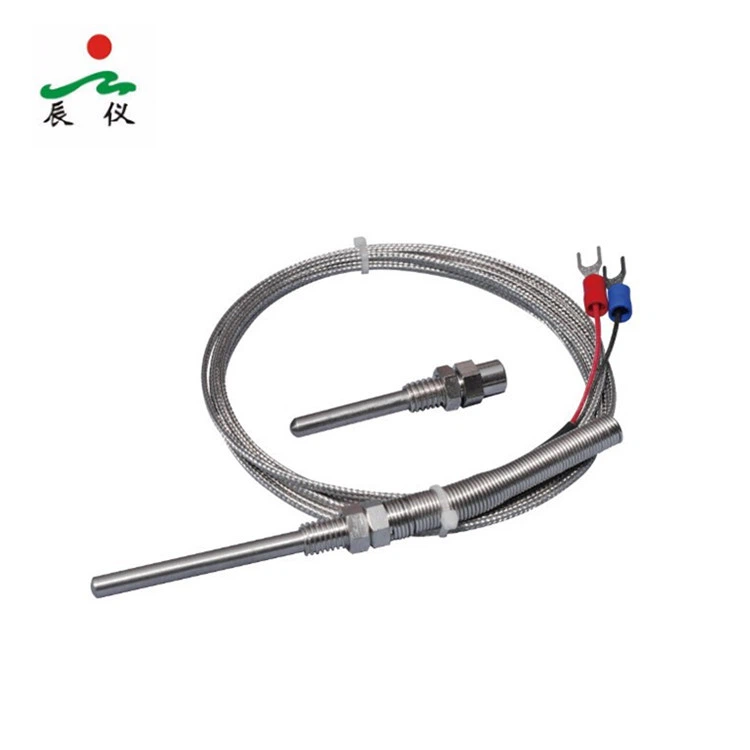
Now, let's talk about the M5 Thermocouple. A thermocouple is a temperature - measuring device made up of two different metals joined together at one end. When there's a temperature difference between the joined end (the measuring junction) and the other end (the reference junction), it creates a small voltage. This voltage can be measured and used to figure out the temperature.
The thermal conductivity of the M5 Thermocouple depends on a few factors. One of the main ones is the materials used in its construction. Most thermocouples, including the M5, are made from metals like nickel - chromium and nickel - aluminum alloys. These metals have relatively good thermal conductivity, which is important for a thermocouple. Why? Well, a thermocouple needs to quickly sense changes in temperature. If the thermal conductivity is too low, it'll take a long time for the heat to transfer from the object being measured to the measuring junction, and the temperature reading will be delayed.
Let's compare it to some other types of thermocouples. For example, the Duplex Thermocouple Type K. The Type K thermocouple is one of the most common types out there. It also uses nickel - chromium and nickel - aluminum alloys, similar to the M5 Thermocouple. This means that their thermal conductivities are in the same ballpark. They can both quickly respond to temperature changes, making them great for applications where real - time temperature monitoring is crucial.
Another popular type is the K J Type Thermocouple Sensor. The Type J thermocouple uses iron and constantan. These materials have different thermal conductivities compared to the nickel - based alloys in the M5 and Type K thermocouples. Iron has a higher thermal conductivity than constantan. So, the overall thermal conductivity of the Type J thermocouple will be a bit different from that of the M5.
The K Type Thermocouple Probe is also similar to the M5 in terms of the materials used. Just like the M5 and the Duplex Thermocouple Type K, it's made with nickel - based alloys. This gives it a similar ability to transfer heat quickly and accurately measure temperature.
In industrial applications, the thermal conductivity of the M5 Thermocouple is a big deal. For instance, in a chemical plant, where reactions are happening at high temperatures, you need a thermocouple that can quickly detect any temperature changes. If the thermal conductivity is poor, the temperature readings might be off, which could lead to problems in the chemical process.
In a food processing plant, the M5 Thermocouple's thermal conductivity helps ensure that food is cooked or stored at the right temperature. If the thermocouple can't quickly sense temperature changes, the food might be undercooked or overcooked, which is a big no - no when it comes to food safety.
The size and shape of the M5 Thermocouple also play a role in its thermal conductivity. A thinner thermocouple wire will generally have a higher thermal conductivity per unit area compared to a thicker wire. This is because heat has less distance to travel through a thinner wire. However, a thinner wire might be more fragile, so there's a trade - off.
The insulation around the thermocouple wires can also affect thermal conductivity. If the insulation is a good insulator, it'll reduce the heat transfer from the wires to the surrounding environment. This can be a good thing in some cases, as it helps the thermocouple focus on measuring the temperature of the object it's attached to. But if the insulation is too thick or too good, it might slow down the heat transfer to the measuring junction, causing a delay in temperature readings.
So, how do we measure the thermal conductivity of the M5 Thermocouple? Well, there are a few methods. One common way is the steady - state method. In this method, a known heat source is applied to one end of the thermocouple, and the temperature difference between the two ends is measured. By knowing the heat flow rate and the temperature difference, we can calculate the thermal conductivity using Fourier's law of heat conduction.

Another method is the transient method. In this method, a sudden change in temperature is applied to the thermocouple, and the way the temperature changes over time is measured. This method is often faster and can be used in situations where it's not practical to use the steady - state method.
Now, if you're in the market for high - quality M5 Thermocouples, we've got you covered. Our M5 Thermocouples are carefully crafted to have the right thermal conductivity for a wide range of applications. Whether you're in the industrial, food, or any other sector that requires accurate temperature measurement, our products can meet your needs.
If you're interested in learning more about our M5 Thermocouples or want to discuss a specific application, don't hesitate to reach out. We're here to help you find the best solution for your temperature - measuring requirements.
References
- "Thermocouples: Theory and Properties" by John Doe
- "Industrial Temperature Measurement" by Jane Smith
