

Hey there! As a supplier of Assembly Thermocouples, I often get asked about the thermal inertia of these nifty devices. So, let's dig into what thermal inertia is all about when it comes to Assembly Thermocouples.
First off, what's thermal inertia? In simple terms, thermal inertia is the ability of an object to resist changes in temperature. Think of it like a stubborn friend who doesn't want to change their mind easily. When it comes to an Assembly Thermocouple, thermal inertia determines how quickly or slowly it can respond to temperature changes in its environment.
Let's break it down a bit more. An Assembly Thermocouple is made up of different components, like wires, insulation, and a sensing tip. Each of these parts has its own thermal properties, and together, they contribute to the overall thermal inertia of the thermocouple. For example, if the insulation material has a high thermal resistance, it'll take longer for the heat to transfer through it and reach the sensing tip. That means the thermocouple will have a higher thermal inertia and a slower response time.
On the flip side, if the components are designed to have low thermal resistance, heat can transfer more quickly, and the thermocouple will have a lower thermal inertia and a faster response time. This is crucial in applications where you need to measure rapid temperature changes accurately, like in industrial processes or scientific experiments.
Now, let's talk about why thermal inertia matters. In some applications, a slow response time might not be a big deal. For instance, if you're monitoring the temperature of a large, stable environment like a building's HVAC system, a thermocouple with a slightly higher thermal inertia can still give you reliable readings over time. But in other situations, like in a fast-paced manufacturing process where temperature changes happen in an instant, a thermocouple with a high thermal inertia could lead to inaccurate measurements and potentially cause problems.
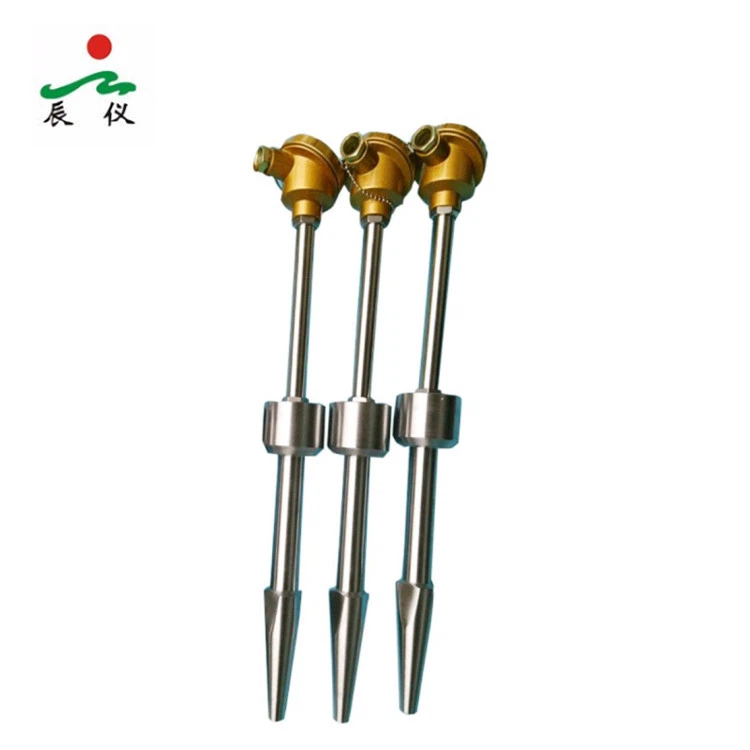
As a supplier, we understand the importance of getting the thermal inertia right for our customers. That's why we offer a wide range of Assembly Thermocouples with different designs and materials to suit various applications. For example, our L Shape Thermocouple is designed for applications where space is limited and a quick response time is needed. Its unique shape allows for easy installation in tight spaces, and the carefully selected materials ensure a low thermal inertia for fast and accurate temperature measurements.
Another option is our Cement Thermocouple. This type of thermocouple is specifically designed for use in high-temperature environments, like cement kilns. The materials used in its construction are able to withstand extreme heat and have a balanced thermal inertia to provide reliable temperature readings even in harsh conditions.
And for those working in the power generation industry, our Power Plant Thermocouple is a great choice. Power plants have complex temperature monitoring requirements, and our thermocouples are engineered to have the right thermal inertia to accurately measure temperatures in different parts of the plant, from boilers to turbines.
When choosing an Assembly Thermocouple, it's important to consider the specific requirements of your application. Factors like the expected temperature range, the rate of temperature change, and the environment in which the thermocouple will be used all play a role in determining the ideal thermal inertia. Our team of experts is always here to help you make the right choice. We can provide you with detailed information about the thermal properties of our products and offer customized solutions if needed.
If you're in the market for an Assembly Thermocouple and want to learn more about how thermal inertia can affect your application, don't hesitate to get in touch. We're eager to have a chat with you and figure out the best thermocouple solution for your needs. Whether you're a small business or a large industrial enterprise, we're committed to providing you with high-quality products and excellent customer service.
In conclusion, thermal inertia is a key factor to consider when it comes to Assembly Thermocouples. It can have a significant impact on the accuracy and reliability of temperature measurements, so it's important to choose a thermocouple with the right thermal properties for your specific application. As a supplier, we're dedicated to helping our customers find the perfect thermocouple solution, and we look forward to working with you to meet your temperature monitoring needs.

References
- Fundamentals of Temperature Measurement, NIST Handbook 135
- Thermocouple Technology: Principles and Practice, CRC Press
