

Hey there! As a supplier of L Shape Thermocouples, I often get asked about the heat transfer coefficient of these nifty devices. So, I thought I'd take a deep dive into this topic and share some insights with you.
First off, let's quickly go over what an L Shape Thermocouple is. An L Shape Thermocouple, as the name suggests, has an L-shaped design. This unique shape makes it super useful in various applications where a standard straight thermocouple just won't cut it. You can check out our L Shape Thermocouple on our website to get a better idea of its look and features.
Now, onto the main question: What is the heat transfer coefficient of an L Shape Thermocouple? The heat transfer coefficient, often denoted as 'h', is a measure of how well a material or device can transfer heat. It's basically a number that tells you how fast heat can move from one place to another through the thermocouple.
There are a few factors that can affect the heat transfer coefficient of an L Shape Thermocouple. One of the big ones is the material it's made of. Different materials have different thermal conductivities, which directly impact how well they transfer heat. For example, metals like copper and aluminum are known for their high thermal conductivities, so if an L Shape Thermocouple is made with these materials, it'll likely have a higher heat transfer coefficient.
Another factor is the surface area of the thermocouple. The larger the surface area, the more area there is for heat to transfer. An L Shape Thermocouple's unique shape can actually give it an advantage here. The bent part of the 'L' can increase the overall surface area compared to a straight thermocouple, allowing for more efficient heat transfer.
The fluid or medium around the thermocouple also plays a role. If the thermocouple is in a gas, like air, the heat transfer will be different compared to if it's in a liquid, like water. Gases generally have lower heat transfer coefficients than liquids because the molecules in gases are more spread out and don't transfer heat as effectively.
Let's talk about some real - world applications. In power plants, Power Plant Thermocouples are crucial for monitoring temperatures at various points. An L Shape Thermocouple can be a great choice here because it can be easily installed in tight spaces. The heat transfer coefficient is important in power plants because accurate temperature measurements rely on efficient heat transfer. If the heat transfer coefficient is too low, the thermocouple might not respond quickly enough to temperature changes, leading to inaccurate readings.
Another application is in industrial processes where right - angled measurements are needed. Right Angle Thermocouples are similar to L Shape Thermocouples and are used in these situations. For example, in a manufacturing process where a machine has components at right angles to each other, an L Shape Thermocouple can be used to measure the temperature at those specific points.
To calculate the heat transfer coefficient of an L Shape Thermocouple, we usually rely on empirical correlations. These correlations are based on a lot of experiments and data. However, it's important to note that these are just estimates, and the actual heat transfer coefficient can vary depending on the specific conditions.
One common way to estimate the heat transfer coefficient is by using the Nusselt number (Nu). The Nusselt number is a dimensionless number that relates the convective heat transfer to the conductive heat transfer. It's calculated using equations that take into account factors like the thermophysical properties of the fluid, the flow velocity, and the geometry of the thermocouple.
In practice, when you're using an L Shape Thermocouple, you might not always need to calculate the heat transfer coefficient yourself. Most thermocouple manufacturers, including us, provide some general guidelines and performance data for their products. This data can give you an idea of how well the thermocouple will transfer heat under typical conditions.
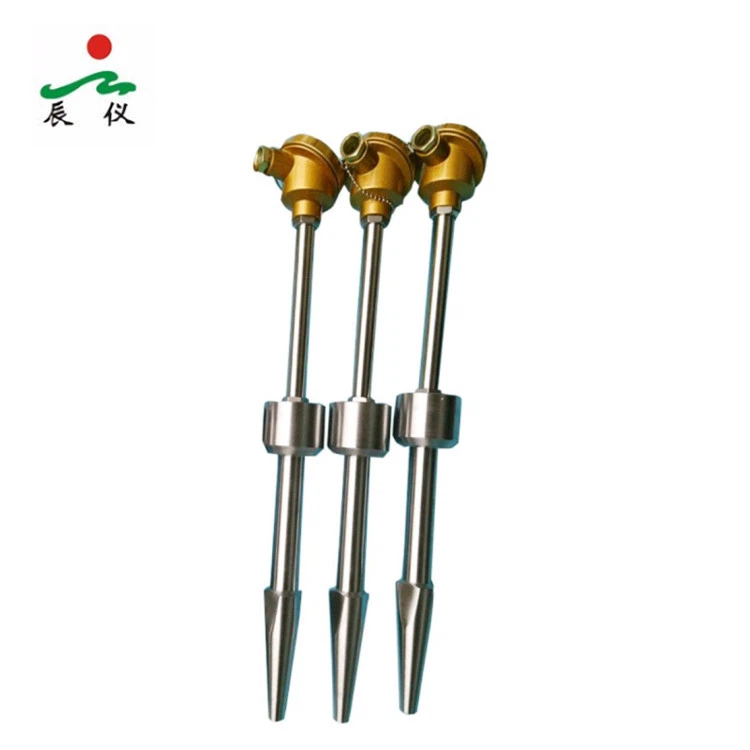

But if you're in a situation where you need a more accurate measurement of the heat transfer coefficient, you might need to do some on - site testing. This could involve using specialized equipment to measure the temperature differences and heat fluxes around the thermocouple.
So, why should you choose our L Shape Thermocouples? Well, we've spent a lot of time perfecting our manufacturing process to ensure that our thermocouples have optimal heat transfer coefficients. We use high - quality materials that are known for their good thermal properties. And our design team has worked hard to create an L Shape that maximizes the surface area for efficient heat transfer.
If you're in the market for L Shape Thermocouples or any other type of thermocouples, we'd love to have a chat with you. Whether you're working on a power plant project, an industrial process, or any other application that requires accurate temperature measurement, we can provide you with the right products and the support you need. Just reach out to us to start a conversation about your specific requirements.
In conclusion, the heat transfer coefficient of an L Shape Thermocouple is an important factor that affects its performance. It's influenced by the material, surface area, and the surrounding medium. Understanding this coefficient can help you make better decisions when it comes to choosing the right thermocouple for your application. And if you're looking for a reliable supplier of L Shape Thermocouples, we're here to help.
References
- Incropera, F. P., & DeWitt, D. P. (2002). Fundamentals of Heat and Mass Transfer. Wiley.
- Holman, J. P. (2002). Heat Transfer. McGraw - Hill.
