

As a supplier of the WRe526 Thermocouple, I often encounter questions from customers regarding its various properties, one of the most frequently asked being about its thermal conductivity. In this blog post, I will delve into the concept of thermal conductivity, specifically focusing on the WRe526 Thermocouple.
Understanding Thermal Conductivity
Thermal conductivity is a fundamental property of materials that describes their ability to conduct heat. It is defined as the quantity of heat (in watts) transmitted through a unit thickness (in meters) of a material in a direction normal to a surface of unit area (in square meters) due to a unit temperature gradient (in kelvins per meter) under steady-state conditions. The SI unit for thermal conductivity is watts per meter-kelvin (W/(m·K)).
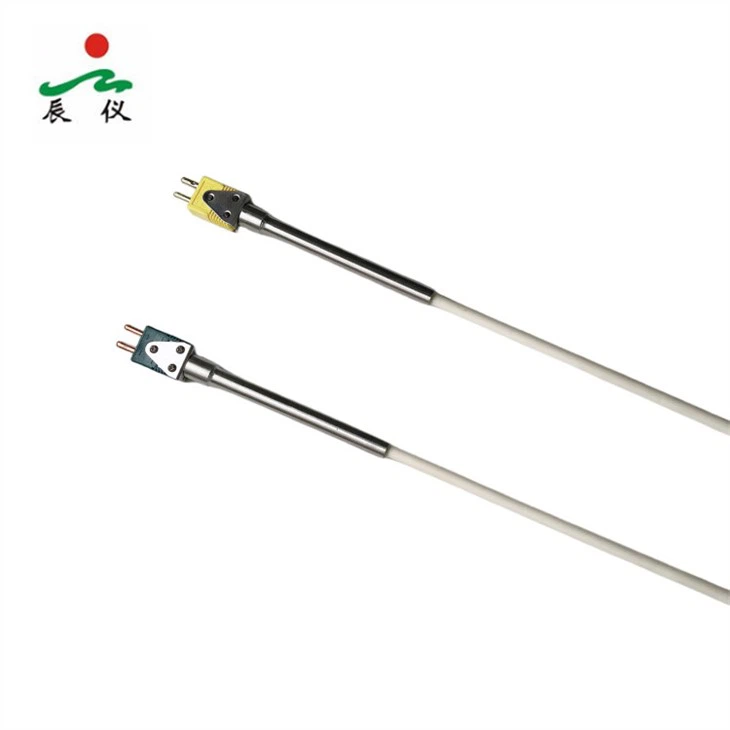

A high thermal conductivity means that a material can transfer heat quickly, while a low thermal conductivity indicates that the material is a poor conductor of heat and is more of an insulator. For thermocouples, thermal conductivity plays a crucial role in their performance, as it affects how efficiently they can sense temperature changes and transfer that information.
The WRe526 Thermocouple: An Overview
The WRe526 Thermocouple is a type of high-temperature thermocouple made from a tungsten-rhenium alloy. Tungsten-rhenium thermocouples are known for their excellent performance in extreme environments, including high temperatures, high pressures, and corrosive atmospheres. The "WRe526" designation refers to the specific composition of the alloy, with the numbers indicating the percentage of rhenium in the two legs of the thermocouple.
These thermocouples are commonly used in industries such as aerospace, metallurgy, and power generation, where accurate temperature measurement at high temperatures is essential. They can operate at temperatures up to 2300°C, making them suitable for applications where other types of thermocouples would fail.
Thermal Conductivity of the WRe526 Thermocouple
The thermal conductivity of the WRe526 Thermocouple is influenced by several factors, including its composition, temperature, and the physical state of the material.
Composition
The addition of rhenium to tungsten in the WRe526 Thermocouple affects its thermal conductivity. Rhenium is a refractory metal with high melting and boiling points, and its presence in the alloy can modify the electronic and atomic structure of the material, thereby changing its thermal conductivity. Generally, as the rhenium content increases, the thermal conductivity of the alloy decreases. This is because rhenium atoms disrupt the regular lattice structure of tungsten, scattering the heat-carrying electrons and reducing their mean free path.
Temperature
Temperature also has a significant impact on the thermal conductivity of the WRe526 Thermocouple. At low temperatures, the thermal conductivity of metals is mainly determined by the movement of free electrons. As the temperature increases, the lattice vibrations (phonons) become more significant, and they can scatter the electrons, reducing the thermal conductivity. For the WRe526 Thermocouple, the thermal conductivity typically decreases with increasing temperature, although the exact relationship depends on the specific composition of the alloy.
Physical State
The physical state of the WRe526 Thermocouple, such as its density, grain size, and crystal structure, can also affect its thermal conductivity. A dense, well-annealed material with a large grain size will generally have a higher thermal conductivity than a porous or fine-grained material. This is because the boundaries between grains can scatter the heat-carrying electrons and phonons, reducing their ability to transfer heat.
Measuring the Thermal Conductivity of the WRe526 Thermocouple
Measuring the thermal conductivity of the WRe526 Thermocouple accurately can be challenging due to its high operating temperature and the need to maintain a stable temperature gradient. Several methods can be used to measure thermal conductivity, including the steady-state method and the transient method.
Steady-State Method
The steady-state method involves applying a known heat flux to the thermocouple and measuring the resulting temperature difference across a known distance. By using Fourier's law of heat conduction, the thermal conductivity can be calculated. This method is relatively simple and accurate, but it requires a long time to reach a steady-state condition, especially at high temperatures.
Transient Method
The transient method measures the thermal conductivity by observing the temperature response of the thermocouple to a sudden change in heat input. This method is faster than the steady-state method and can be used at higher temperatures. However, it requires more complex equipment and data analysis.
Importance of Thermal Conductivity in Thermocouple Performance
The thermal conductivity of the WRe526 Thermocouple is important for several reasons.
Response Time
A thermocouple with a high thermal conductivity can transfer heat quickly from the measurement environment to the sensing junction, resulting in a faster response time. This is crucial in applications where rapid temperature changes need to be detected, such as in combustion processes or high-speed manufacturing.
Accuracy
The thermal conductivity of the thermocouple can also affect its accuracy. If the thermal conductivity is too low, the thermocouple may not be able to sense temperature changes accurately, leading to measurement errors. On the other hand, if the thermal conductivity is too high, the thermocouple may be more susceptible to heat losses to the surroundings, also affecting the accuracy of the measurement.
Stability
The thermal conductivity of the WRe526 Thermocouple can influence its stability over time. A thermocouple with a stable thermal conductivity will provide consistent temperature measurements, even under varying operating conditions. This is important for applications where long-term reliability is required, such as in industrial processes or scientific research.
Comparison with Other Thermocouples
When comparing the thermal conductivity of the WRe526 Thermocouple with other types of thermocouples, it is important to consider the specific application requirements.
Platinum Rhodium Thermocouple
Platinum rhodium thermocouples are another type of high-temperature thermocouple commonly used in industrial applications. They have a lower thermal conductivity than the WRe526 Thermocouple, which can result in a slower response time. However, they are more stable and have a wider temperature range, making them suitable for applications where accuracy and long-term stability are more important than fast response.
S Type Thermocouple With Plug
The S type thermocouple with plug is a popular choice for general-purpose temperature measurement. It has a relatively low thermal conductivity compared to the WRe526 Thermocouple, which can limit its use in applications where rapid temperature changes need to be detected. However, it is more affordable and easier to use, making it suitable for a wide range of applications.
Conclusion
In conclusion, the thermal conductivity of the WRe526 Thermocouple is an important property that affects its performance in high-temperature applications. It is influenced by factors such as composition, temperature, and physical state, and it plays a crucial role in determining the response time, accuracy, and stability of the thermocouple. When choosing a thermocouple for a specific application, it is important to consider the thermal conductivity along with other factors such as temperature range, accuracy, and cost.
If you are interested in learning more about the WRe526 Thermocouple or are considering purchasing thermocouples for your application, please feel free to contact us. We are a leading supplier of high-quality thermocouples, including the WRe526 Thermocouple, and we can provide you with the technical support and products you need.
References
- Incropera, F. P., & DeWitt, D. P. (2002). Fundamentals of Heat and Mass Transfer. John Wiley & Sons.
- NIST Standard Reference Database 123. (n.d.). Thermophysical Properties of Matter. National Institute of Standards and Technology.
- Ruff, A. W., & Clark, R. B. (1976). Thermocouples: Theory and Practice. Instrument Society of America.
